Weather causes smaller sized tree fruit to start the Chilean season
Weather causes smaller sized tree fruit to start the Chilean season
Summit Produce Inc., headquartered in Fresno, CA, is the commercial arm of Gesex, which is recognized as a specialist in the production, packaging and sale of fresh high-quality fruit originating from the Southern Hemisphere. Summit Produce manages the label and brings promotable volume of high-quality fruits to the U.S. market.
Victor Arriagada, general manager of Summit Produce, explained that Gesex’s goal is to have maximum integration from the farms to the final customer.
“In order to achieve that goal, 90 percent of the fruit we ship is produced on our own farms, processed in our own packinghouses, exported by Gesex, our own company, and received and distributed in the final market at our own commercial offices — one in the U.S., which is Summit Produce, and the other in China,” said Arriagada.
Summit Produce has been developing and facilitating direct programs with U.S. retailers and other customers for the past four years. Its approach to the market is to develop a true premium program during the winter with stone fruits and grapes.
“We have had great success with several large and mid-size retailers and premium wholesalers,” said Arriagada. “We are now developing a few programs with foodservice companies.
“Gesex’s progressive mindset and investment in new varieties in breeding partnerships keep our programs fresh, innovative and custom tailored to every customer’s needs,” he continued. “As growers, we make quality control a priority throughout the entire production line.”
Summit Produce’s Chilean lineup includes cherries, grapes, nectarines, peaches, plums, apricots, pluots, kiwi and citrus fruits, all in numerous varieties and categories that provide the company with nearly year-round shipments of varying fruits from Chile.
The company recently added a new farm in Copiapó in northern Chile. “This farm will provide us with access to early grapes, which began in mid-December,” said Arriagada. “It matches with our central area production and will keep us going until the end of the season.”
In early December he explained that because Chile had an uneven spring, it has more availability of small sized tree fruit at the early part of the season with delays of five to seven days. Inconsistency of temperatures during the spring resulted in the smaller sizes for the early season. Some hail events definitely affected items, including cherries and apricots.
“We expect mid- and late-season varieties of tree fruits to be in the normal range,” he said. “Condition and Brix levels should be good.”
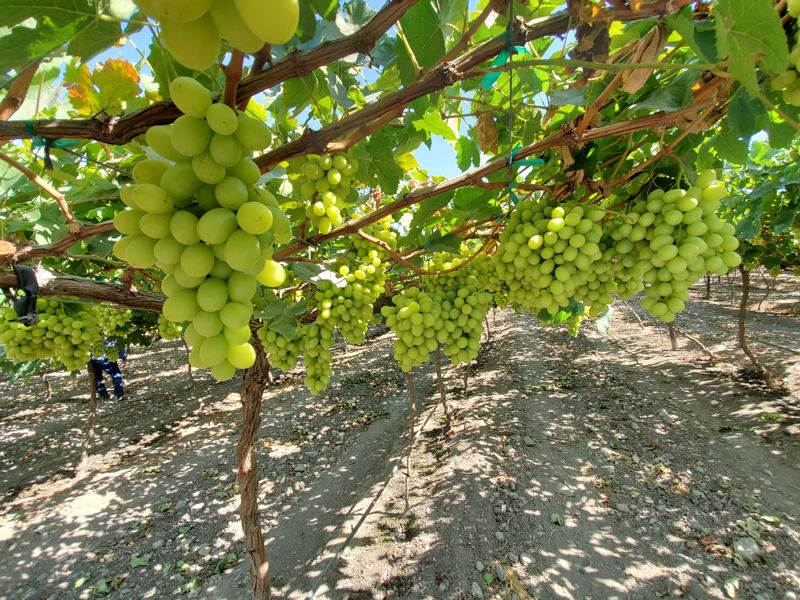
On grapes, the northern areas of Chile will be somewhat erratic depending on farms and fields. But Arriagada said it appears the trend for northern growers is to avoid December arrivals into the U.S. because of the strong presence of California and Peruvian grapes.
The crop of red grapes in the central area of Chile looks normal, other than being delayed by about one week.
“It is still too early to say how the central area will fare,” said Arriagada. “But at our farms work is delayed one week, which is determined by growth stage. We are working bunches [clusters] in order to have an even maturity.
“Regardless, we are seeing less fruit on green grapes — or adjusted quantity of bunches — so it should be comparable with last season’s production per hectare,” he continued. “In total numbers, production should not be different than last year. The question mark will be determined by market expectation, reality of other markets and exchange rates.”
He added that at this time the summer citrus movement is expected to be normal: June, July and August for citrus, and June through August on kiwi.
Arriagada pointed out that the main challenge for Chilean exporters this season will be their own expectations of the market due to the exchange rate, which is strong for the U.S. dollar.
“This tempts exporters to send a lot of fruit and of variable quality,” he said. “However, I’m pretty confident that the lessons learned in previous years will prevail.”
Summit Produce services primarily retailers and wholesalers. In addition to its Fresno facility, the company has a commercial operation at the port Of Wilmington in Delaware. Canada is serviced by Summit Produce’s partner, North American Produce, based in Toronto.