Washington apple producers set to harvest third-largest crop
Washington apple producers set to harvest third-largest crop
This season Washington's apple producers are slated to harvest their third-largest crop. According to the Washington State Tree Fruit Association, 125.2 million standard 40-pound boxes of fresh apples are expected to be harvested. While this would be down approximately 10.5 percent from the 2014 record crop of 140 million boxes, it is just behind the state's second-largest harvest of 128.3 million boxes marketed during the 2012-13 season.
The numbers reflect the ways in which production by variety is changing in response to consumer preferences.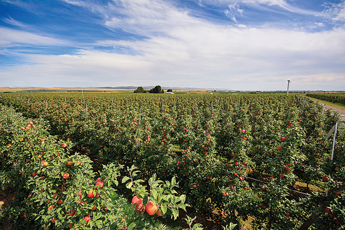 Preliminary estimates show that Washington apple producers are expected to harvest 125.2 million boxes of apples during the 2015-16 season. (Photo courtesy of Stemilt Growers LLC) “Red Delicious remains the most numerous variety with a projected 25 percent of production,” the association reported.” "Gala is close behind at 23 percent, followed by Fuji at 13.7 percent and Granny Smith at 13 percent of total production. This year, Honeycrisp is forecast to come in at 7 percent of the total crop, which would move it past Golden Delicious to become the fifth-ranked variety by production volume in Washington state.”
Communications Manager Stephanie Chance said Golden Delicious is estimated to be 6.8 percent of the total crop, with all other apple varieties in Washington taking up the balance.
“Consumers can expect to enjoy an ample supply of delicious Washington apples this year,” said President Jon DeVaney in early August. “Washington apples are prized around the world because of our growers’ commitment to quality and responsiveness to consumer tastes, and the size of our crops are growing to meet this demand.”
The harvest started at the beginning of August for early varieties. Production typically peaks in September and October, finishing in November.
Washington continues to experience effects of the ongoing drought in the West. “Water supplies have been curtailed overall, but the specific impacts depend on the irrigation district supplying a particular orchard,” DeVaney explained. “Some irrigation districts or individual water rights are more senior, and the impacts are felt first and most severely on the holders of junior water rights.”
And this year's fire season made national headlines. “It is a very hot and dry summer, which has contributed to a number of fires from the large one near Wenatchee to smaller brush fires,” he told The Produce News. “For growers who get the edges of their orchards singed, this is bad news. But the overall effect on the crop size has been negligible.”
DeVaney said sizing will be down from last season, but added that, “the last two seasons had above-average sizing. That's on an aggregate basis, and sizing is influenced by what growers do in the orchard (thinning) and by variety. Later varieties still have a couple of months of growth ahead of them.”