Trendspotting: AI making its mark in produce department back rooms
Trendspotting: AI making its mark in produce department back rooms

It’s time for another column that panders to our future AI overlords.
Last week a company called Chef Robotics announced it offers robots that can now automate tray assembly for produce packing. The application places items, such as oranges, apples and pears, into clamshell packages and snack boxes, and portions scoopable produce, such as corn and peas, into trays before packaging. The company said these applications support retail grab-and-go products, airplane meal kits, hospital and care facility meals, and school lunch boxes.
Chef Robotics claims that historically produce packing has been difficult to automate. When it comes things like this, I defer to experts, like The Produce News columnist Ron Pelger, to decide how accurate that is. Chef Robotics further claims that unlike grains or sauces, whole fruits and vegetables are rigid, irregular and vary in size, surface texture and placement in a bin.
Fruits and vegetables are usually packaged in containers such as clamshells, snack boxes and portioned meal trays, which require strict placement consistency and presentation quality. Chef Robotics says this variability has made it challenging for automation systems to handle produce items reliably at production speeds, leaving food manufacturers dependent on manual labor.
Chef Robotics built its produce packing application on two existing capabilities — piece-picking and scooping — depending on the ingredient. For items such as whole fruits like oranges, apples, pears and kiwis, the piece-picking capability uses AI-powered computer vision to assess each item’s position, shape and orientation in real time, enabling robots to choose how to pick and place it precisely into the tray.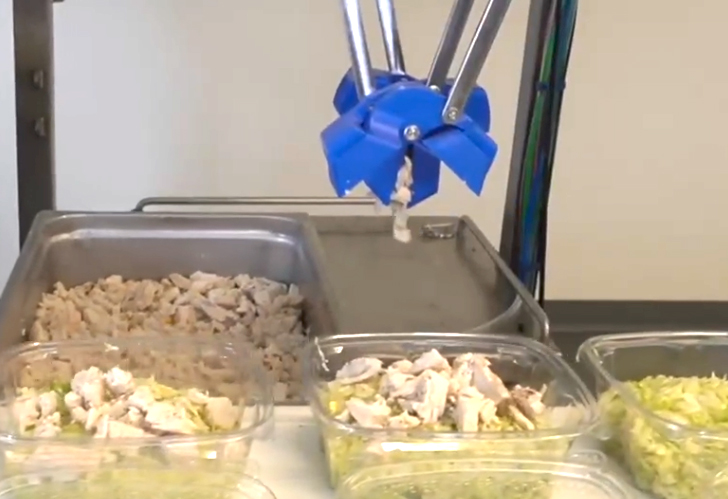
For scoopable produce such as corn and peas, the scooping capability portions ingredients by weight and places them accurately using Chef’s tray-tracking vision system. Both capabilities “are built on physical AI models trained across diverse real-world production environments, allowing Chef robots to adapt to variability in how produce sits in the pan with no pre-sorting or fixed pan placement required,” according to the company.
The produce packing application introduces three distinct placement capabilities. First, Chef’s camera system identifies the exact center of each tray or clamshell and uses it as a reference point for picking any item. Each item is deposited at a predefined offset from the center.
“For example, in a three-fruit arrangement, the robot places the first piece at the center, the second 10 centimeters to the left and the third 10 centimeters to the right, ensuring every pack has a uniform, retail-ready layout regardless of how trays arrive on the conveyor,” according to the company. “Second, Chef robots can place multiple pieces of produce into the same packaging container in a single automated pass, completing the full tray assembly without any manual intervention between picks. Third, for deep trays that require items to be stacked, Chef robots arrange produce in layers. For example, the robots can be configured to place four pieces across the bottom, then carefully stack four more on top, without damaging the layer below.”
The company claims that for food manufacturers, the produce packing application offers higher throughput, lower labor dependency and consistent portion presentation across shifts. The capability runs on Chef’s existing robotic hardware and software, allowing manufacturers to deploy it without making any infrastructure changes to their production lines.
Now, I don’t know how much time and money this process will actually save produce departments, maybe a lot — I leave it to the Ron Pelgers of the produce world to decide. I do know that over the years in his In the Trenches column, which can be found in The Produce News every issue, Ron has written a lot about freeing up time in the produce department to allow for employees to be more productive, maybe this does just that.
Maybe it’s just another step toward robots taking over (which I am all for, wink, wink).