In the Trenches: Mushroom merchandising from past to present
In the Trenches: Mushroom merchandising from past to present
While engaged in research for a customer assignment, I came across some black-and-white store photographs people gave me over the years, knowing that I have an interest in vintage supermarket photos.
Several photos from the early 1950s reveal produce displays in the back of the stores where produce departments were normally located during that period of time. It’s difficult to believe that produce departments in those days were not treated or supported with appreciation as they are today. A supermarket display of mushrooms in the 1950s (below) compared with one in 2015 (above) demonstrates how the category has matured over the years.
In browsing through my photos, a particular package of mushrooms displayed on a wall case caught my attention. I was amazed that there were no other mushrooms displayed except two small rows. The choice of mushrooms for consumers in those days was “one size will have to fit all.” But that all changed when organizations emerged for the purpose of educating consumers and promoting mushrooms.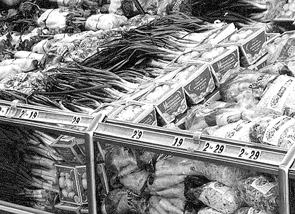
In January of 1955, the American Mushroom Institute was formed as a non-profit organization to help promote fresh mushrooms. Then in 1985, the National Mushroom Growers’ Association came into fruition for the purpose of expanding the promotion on a national level. Afterward, the Mushroom Promotion & Consumer Information Act was passed by Congress, which led to the establishment of the Mushroom Council in 1993.
With the help of these organizations, the mushroom era began its long journey to where it is today. Thanks to these groups, we now have many more choices of mushrooms for consumers rather than just one lonely package on retail displays.
A good portion of the mushroom growth was generated by educating consumers. The acknowledgment that mushrooms contain many healthy attributes and nutritional value has encouraged consumers to eat more of them.
Shoppers are now more sophisticated in making purchases of mushrooms, which is boosting the volume level to new heights. This indicates that consumers are willing to try additional varieties.
With the positive direction in which mushrooms are headed, it is imperative that the retail store level keeps pace with this sales growth trend. Retailers should re-evaluate their entire mushroom category. It is timely to expand current display sections now. Increasing space will certainly boost mushroom sales even further.
In conjunction with the Mushroom Council, Steve Muro, president of Fusion Marketing in Chatsworth, CA, told me, “From 2009 to 2014, mushroom category volume grew nearly 14 percent. In the past 12 months, the volume of organic mushrooms increased 21 percent at retail.”
These impressive statistics should be evidence enough to reassess and expand current mushroom sections in the produce departments. Fast-growing consumer demand for mushrooms will continue on an upward scale. Current four-foot sections will be insufficient to satisfy that demand. With all the additional varieties and innovated packaging choices, mushroom sections today are increasing up to 12 feet wide.
The new mushroom trend today is the blendability concept. It consists of mixing chopped mushrooms into hamburgers and other ground meat items for a healthier and tastier meal.
“The Blend program is a new way of retailing mushrooms, a new business model that benefits both retailer and shopper,” said Moro. “There are millions of transitional meat consumers looking to reduce their intake of red meat for healthier eating options. With The Blend, consumers can still enjoy iconic meat-based foods, but now can add a portion of mushrooms to the meal, which will improve flavor, moisture and texture. The Blend is the perfect solution and once consumers taste a Blend Burger, they are sold on the concept as being a better burger.”
Here is a simple guideline to help expand your mushroom section:
- Reevaluate current display sections at the store level.
- Review and analyze each item on category-management reports.
- Give precedence to the fastest-selling mushroom varieties by expanding their space.
- Incorporate other varieties around your basic high-volume sellers.
- Place dried, jars and miscellaneous mushroom items above the main display.
- Fasten a plastic holding unit on the sign track and fill it with recipes.
- Advertise and promote a different mushroom every week to build sales growth.
Develop your mushroom display into a classy “signature section” to excite and draw customers to it. Use your creativity along with professional workmanship. Place packages neatly keeping them uniform with all labels facing the customer.
Remember that many of the popular television cooking shows are highlighting mushrooms. Consumers watching those programs will be in your stores heading for the mushroom section. Be ready for them.
Browse the mushroomcouncil.org website for some outstanding information on mushrooms and various programs. Also check out The Blend program at mushroomsatretail.com and Fusion Marketing at fusionmarketing360.com for more information.