Terminal market concept drives St. Louis
Terminal market concept drives St. Louis
ST. LOUIS -- The ongoing success of the St. Louis Produce Market is a tribute to the terminal market concept.
Summarizing the comments of others on the market, Jim Heimos, president, Heimos Produce Co. Inc., said the market remains important because it is the focus of customers from near and far who come to St. Louis to buy produce. "This still works for most of us," Heimos said. "There is an advantage for us all to be here. We are competitors but the market does draw. Especially in the summertime."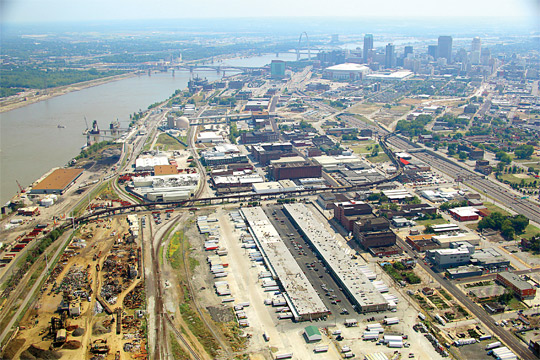 The St. Louis Produce Market is located several blocks north of downtown St. Louis. This is a 2011 aerial shot courtesy of the market.
The St. Louis Produce Market opened in February 1953.
The design structure is basically unchanged in 61 years. The market's merchants have individually upgraded and modernized their refrigeration. The market organization manages security and maintains the facility, including a current effort to replace the roof of the two long docks.
The competitive environment still works as it has for centuries. Competitors group together to give buyers a central location to compare products and prices. It is an efficient operation for the buyers as sellers are forced to offer price and value. The sellers, of course, benefit from a high concentration of buyers to provide the needed environment to offer an array of products. Or, in this case, produce.
In St. Louis, the strongest demand for produce is in the summer months, with farmers markets and similar operations coming to shop from a wide Midwestern ring.
Winters on the market are slower. This winter was brutal in St. Louis, as it was in much of the country.
John Pollaci, president of Sunfarm Food Service Inc., said his business was recovering as the calendar moved toward March. "January was very difficult. Schools, which are a good part of our business, were out for four days in January. People hole up when the weather is that bad. And they spend money on child care. The schools bought less."
Heimos indicated that for the St. Louis produce industry, "It's been a tough winter. There were a lot of transportation issues." But, "there were a lot of good markets because the growing areas had issues. It was hard to function but it created shortages for the certain items."
Providing a historical perspective on the St. Louis Produce Market is stlouisproducemarket.com. "In the early days of St. Louis, when it was still a growing Western town, most of the fruit and vegetables consumed here came to the city on the Mississippi river. In order to be near the source of supply, wholesale merchants set up their businesses near the river, and the first St. Louis produce market grew up at Wharf Street on the bank of the Mississippi.
"As river traffic grew the vegetable dealers moved about a block from the old area. The move was believed to have taken place about 1874, when the Eads Bridge was completed. The industry expanded and the market spread until it covered a 36-acre area where for 75 years it continued to operate. Old Commission Row is now made up of shabby old buildings, most of them pre-dating the Civil War.
In 1947 it became obvious the market would have to move due to the development of the Third Street Inter-Regional Highway and the East St. Louis Bridge. This development would wipe out a large part of the existing market. The Department of Agriculture conducted a survey and made recommendations concerning the construction of a new market. Four sites were suggested for the new market, from which the present one at North Market and Second was chosen.
The project was financed by the St. Louis Fruit & Produce Association, made up of some of the produce merchants. In August 1950, work had begun by the Robinson Construction Co."
The website noted, "From the rear of the produce market, fruits and vegetables were unloaded from freight cars directly to the dealers."
Those tracks are still available to the St. Louis produce merchants today.