Tarheel 2014 sweet potato harvest will be back to normal
Tarheel 2014 sweet potato harvest will be back to normal
BENSON, NC — North Carolina's sweet potato harvest, still in full swing at mid-September, is back to normal, and none too soon. After two years in a row of below-average acreage planted due to weather, the 2014 crop is growing on 66,000 acres. That's the USDA estimate cited by Sue Johnson-Langdon, executive director of the North Carolina Sweet Potato Commission, here. The feds predict that 65,000 of those acres will be harvested, equal to almost half of the nation's crop.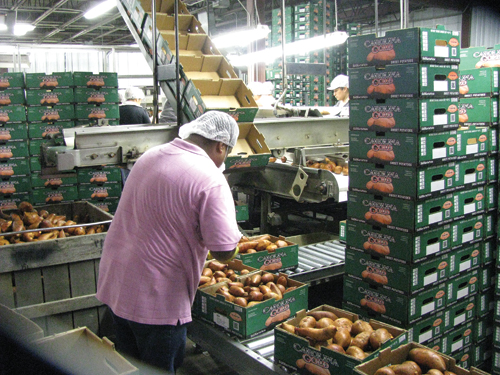 Sweet potatoes (Suss Kartoffeln) bound for the German market are processed and packed at Vick Family Farm near Wilson. North Carolina is the leading U.S. grower of sweet potatoes, and 20 percent are exported overseas, mainly to Europe.
In 2013, wet weather hampered planting of the seedling sprouts. "We had a rain of biblical proportions in North Carolina," Johnson-Langdon explained. "That held the crop down to about 54,000 acres planted. This year, we're up 22 percent in estimated acreage planted, and we've had an uneventful growing season, good weather generally. We should have plenty of sweet potatoes for Thanksgiving this year."
The short crop last year resulted in some growers in late August running out of supplies of stored 2013 sweet potatoes before they could harvest and cure their 2014 crop. Curing takes five to 10 days, and then they are stored at 55-60 degrees for up to a year. The favorite variety of sweet potato grown in North Carolina is the Covington, named after a North Carolina State University researcher and industry leader who developed the variety. Johnson-Langdon estimated that 90 percent of the sweet potatoes grown in the state are Covingtons.
The North Carolina Agribusiness Council estimated on Sept. 14 that about 27 percent of the sweet potato crop in the state had been harvested. Planting hit a high in 2011 in North Carolina, according to the U.S. Department of Agriculture. Of 134,000 acres planted nationwide, 65,000 were in the Tarheel state. Yields were 208 hundredweight bags per acre, nationwide and 200 hundredweight in North Carolina. Acreage planted dropped in 2012 to 130,500 nationwide and 63,000 in North Carolina, with yields at 209 hundredweight nationwide and 200 hundredweight in North Carolina.
Joey Hocutt, produce grower at Triple J Produce in Sims, NC, expected to continue harvesting his 1,300 acres of sweet potatoes, including 150 organic acres, until Nov. 18. The weather had been good, he said, and he had 55 workers for the harvest under the federal H2A worker program.
At Vick Family Farms in Wilson, NC, Jerome Vick, who first harvested sweet potatoes in 1985, said Sept. 19 his harvest was "back to normal" after a wet 2013 held down plantings. "We use the same workers to do tobacco and then sweet potatoes, but this year tobacco is a little late and sweet potatoes are a little early, so we're short on labor. Other than that, we're seeing good yields and having a good harvest, now about 25 percent complete," he said.
Charlotte D. Vick, partner and director of sales and marketing, said Vick Family Farms had expanded its sweet potato fields to more than 1,000 acres and is building a new 25,000-square-foot curing and storage facility that can hold 180,000 bushels of sweet potatoes to accommodate demand from the new dehydration facilities nearby.
Ham Produce Co. in Snow Hill, one of the larger U.S. sweet potato growers, is expanding production by 50 percent this year, to 13,000 acres. With its dehydration facility in Farmville (see "Two new sweet potato dehydration facilities to open in North Carolina," The Produce News, Sept. 22, 2014, page 2) now open, Stacy Ham, vice president, said, "Here we go again, expanding our sweet potato production by 50 percent again this year." Ham Produce and its 65 full-time, year-round workers started harvesting its crop in late August and will continue into November.
Johnson-Langdon pointed out that value-added processing has resulted in new sweet potato products that have extended shelf life and increased sales. She rattled off examples: microwaveable sweet potatoes and sweet potato chips and fries; vodka and beer; pancake, pie and muffin mix; baby food; juice drinks; and crackers. About 20 percent of the North Carolina sweet potato crop is exported via container ships on a 10-14 day journey to 19 countries, mostly in Europe.
"With the new dehydration plants for sweet potatoes opening in the state in the coming year, our 300 sweet potato growers will be able to sell all their crop, including those too large or small for retail, and new markets will open for pet food, animal feed and juice drinks," she noted. The dehydration plants will use the 25 percent to 30 percent of the sweet potatoes left in the field and not harvested now, she added.