Table grape industry growth anticipated into the future
Table grape industry growth anticipated into the future
California's table grape industry is alive and thriving. Barry Bedwell, president of the California Fresh Fruit Association, provided The Produce News with a snapshot of the industry and the ways in which it is evolving.
“California's table grape crop value has continued to increase in recent years and has been more than $1 billion each season since 2004. Today, it is estimated at $1.8 billion.”
At the current time,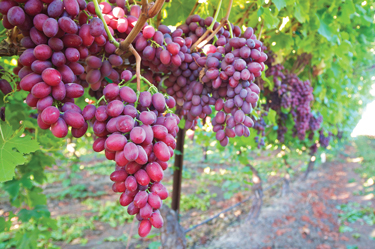 Volume for California's table grape growers has continued to increase in recent years. Cultivation practices — including planting of newer varieties, higher product yield and trellising practices — have had a positive impact on the industry. (Photo courtesy of Anthony Vineyards) Bedwell said approximately 460 growers and marketers are producing and moving 117 million boxes of table grapes annually.
Table grape acreage, he went on to say, has remained relatively stable in recent years. According to collected data, California has a total of 928,000 acres planted to grapes for all purposes. Of this total, 121,000 acres are devoted to table grape production. Raisin varieties, which can be used for fresh or wine production, are grown on another 192,000 acres. Wine vineyards account for the balance of production at 615,000 acres.
Although the number of acres for raisin grapes is higher than acreage for table grapes, Bedwell, “The real difference is in the value of the crops.” He said the value of raisin grapes is approximately $700,000 compared to $1.8 billion for table grapes.
The total volume of California table grapes has continued to increase in recent years for several reasons. “Efficiency is what's really carrying this segment of the industry,” Bedwell commented.
Cultivation practices responsible for increased volume include planting of newer varieties, higher yields on the vines and trellising which allows for higher density planting.
Looking at production over the past three years, Bedwell said the dark-skinned, translucent Scarlet Royal variety occupies the pole position for production, with volume doubling during this time frame. Flame Seedless, a firm and juicy summer grape characterized by a sweet/tart flavor profile, is the second largest by volume. In third position is the green Autumn King, another firm and juicy variety, which is harvested in the fall. Bedwell said Autumn King has also enjoyed a doubling of volume in the past three years.
In fourth position is Crimson Seedless, a variety which is on a declining trend, he went on to say.
Innovations continue to take place at the grower level as new proprietary varieties are commercialized in response to changing consumer preferences and production challenges. Two examples of proprietary grapes are the Holiday Seedless and Cotton Candy grapes.
“Cotton Candy has gathered a lot of attention,” Bedwell commented. “It really tastes like cotton candy.”
Mandatory water restrictions in California have made daily headlines in national news. “Water is a commodity that is commodity- and location-specific,” Bedwell stated. He said both the Coachella Valley and southern San Joaquin Valley have adequate groundwater to lessen the impact for table grape growers. Kern and Tulare counties, major players in the California table grape deal, are situated in the San Joaquin Valley.
“In the short term, we should not see a disruption at all,” Bedwell stated, adding that real impacts could be felt by 2020 and beyond if the water situation in the Golden State does not improve.