Super avocado sales in 2015 portend very bright future
Super avocado sales in 2015 portend very bright future
As of this writing, Super Bowl 2016 — and another Avocados from Mexico commercial — is right around the corner. While the game is surely being anticipated by more people, all segments in the avocado industry are excited about what the ad might do for this year’s sales.
Although it’s impossible to directly credit AFM’s Super Bowl ad in 2015 for the great year that avocados had in the United States, it is seemingly also impossible to ignore its impact.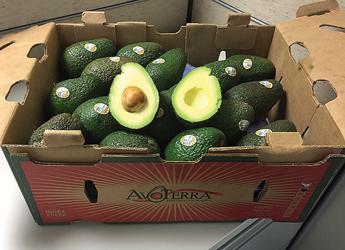 Since 2010, the avocado industry has registered an average increase of 11 percent growth, which was greatly eclipsed in 2015, which saw a total of 2.14 billion pounds sold in the United States — a 16 percent increase over the 1.85 billion pounds sold in 2014.
Emiliano Escobedo, executive director of the Hass Avocado Board, said the numbers don’t lie and avocado sales in 2015 in the United States were “phenomenal” against virtually any measurement. And those increases started with a good sales month in January 2015 and continued to be strong in the period immediately after the Super Bowl in February, which is typically not a great avocado month.
“Ten million more pounds of avocados were sold in February 2015 vs. February 2014,” he said. “Raising awareness is a great way to expand sales.”
The 30-second spot — and AFM’s social media promotions before, during and after the commercial ran — garnered a lot of publicity for the avocados. Many published critiques of the Super Bowl ads gave high marks to the avocado ad for creativity and originality.
Escobedo said that whatever the reason avocado sales in the United States in 2015 showed very impressive growth. “We just finished wrapping up the year,” he said in late January, “and the growth [in sales] was just phenomenal.” Emiliano Escobedo
HAB has its finger on the pulse of the total industry like no other organization because it collects assessments from every handler on a per-pound basis, which enables it and the other avocado commodity groups to fund their programs. The more than $53 million collected in 2015 is spread among the point-of-origin committees and HAB. HAB receives 15 percent of the total assessment while each committee receives the other 85 percent of the funds collected specifically from the avocados produced in the region they represent.
In 2015, a total of 2.14 billion pounds of avocados were sold in the United States — a 16 percent increase over the 1.85 billion pounds sold in 2014. “That means 293 million more pounds were sold in 2015 vs. 2014,” Escobedo said.
Since 2010, the industry has registered an average increase of 11 percent growth. To have that greatly eclipsed in 2015 is mind-boggling. The increase is even more impressive considering Peru sent fewer avocados to the United States in 2015 and California’s crop was also smaller than the year before.
Mexico, Escobedo said, accounted for virtually 100 percent of the increase — and then some. “There was a decline from Peru but a massive surge from Mexico. Mexico shipped 437 million more pounds in 2015. That’s 33 percent growth,” he said.
Now a month into 2016, HAB has a conservative estimate of an increase of 5 percent to 2.25 billion pounds for this year, but it would be no surprise if double-digit growth continues. There are factors that indicate the growth will be much closer to the five-year average than this year’s single-digit prediction.
In the first place, California has a much larger crop. It is expected to be at least 100 million pounds greater than 2015, which in itself is more than a 4 percent total increase in avocado volume.
Escobedo said Peru is one of the wild cards. After a difficult year with regard to pricing for its imports in 2014, Peruvian avocado shippers were very conservative last year, leading to the decrease in volume. They also had some other outlets for their fruit.
Another unknown factor in 2016 is when and if growers in the Mexican state of Jalisco will be granted access to the U.S. market.
“I hate to speculate,” said Escobedo, noting that for the last year many have been predicting that the market would be opened sooner rather than later. But it is a foregone conclusion that it will happen at some point. Jalisco doesn’t have a huge amount of production, but it does have enough to make a difference.
Escobedo said, however, that the largest impact on U.S. consumption in 2016 might be the global market. There were widespread reports in January that Australian avocados were being sold for as much as $14 apiece because of demand in that market. Escobedo said worldwide demand is on the rise, and in the long run he believes there will be sufficient world supply to meet that demand, as there are many agricultural production areas around the world gearing up their avocado volume. But in any given time period, world supplies can be in a demand-exceeds-supply situation.
What is hard to deny, however, is that it is going to be another good year for avocado producers, and the Super Bowl ad on Feb. 7 is figuratively, if not literally, kicking off the season.