SEPC’s STEP-UPP class visits southern Florida
SEPC’s STEP-UPP class visits southern Florida
The Southeast Produce Council’s 2015 STEP-UPP class traveled to southern Florida April 7-10 to visit a variety of well-known produce facilities and farms as part of the program’s ongoing learning experience for class members to develop a greater understanding of the fresh produce industry.
The Southeast Training Education Program for Upcoming Produce Professionals is spearheaded by Faye Westfall, director of sales at DiMare Fresh Tampa, who serves as chairperson, and Tom Page, retired from Supervalu, who serves as vice chairperson.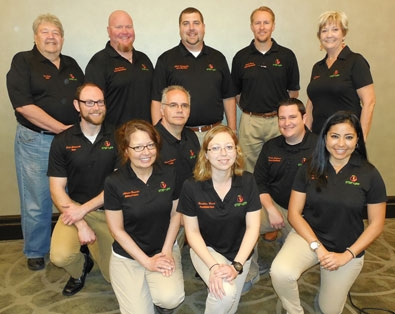 Tom Page (standing left) and Faye Westfall (standing right), coordinators of the Southeast Produce Council’s STEP-UPP program, with this year’s STEP-UPP class: (standing) Andrew Kemp of A&A Produce Co., Chris Kaszanits of BiLo/Winn Dixie, Codie Hair of United Supermarkets, (center) Eric Edwards of Harps, James Spears of Food City, Kevin Cazeaux of Rouses Supermarkets, (kneeling) Alison Rennie of Miitary Produce Group, Heather Hart of Freshfields Farm and Mayra Vazquez of Latin Specialties. More photos available here.
The nine members of the 2015 class on the tour were Alison Rennie of Military Produce Group, Andrew Kemp of A&A Produce Co., Chris Kaszanits of BiLo/Winn Dixie, Codie Hair of United Supermarkets, Eric Edwards of Harps, Heather Hart of Freshfields Farm, James Spears of Food City, Kevin Cazeaux of Rouses Supermarkets and Mayra Vazquez of Latin Specialties.
The 2015 class — the fifth class in the popular program — was announced at the SEPC’s fall conference back in September 2014. So when class members gathered Tuesday evening, April 7, at the Embassy Suites Hotel in Fort Lauderdale, FL, for an opening dinner, it was their first chance to reconnect with one another as they prepared for their visits.
The first stop early Wednesday morning was Brooks Tropicals in Homestead, FL. Mary Ostlund, marketing director at Brooks, welcomed everyone to the company, which was founded by Charlie Brooks in 1928. President Neal Palmer (Pal) Brooks and Chief Executive Officer Greg Smith head the company, which has grown to become a premier grower, packer and shipper of tropical fruit grown in Florida and around the Caribbean, according to the firm’s website.
The company handles a wide variety of items, but is probably best known for its avocados. Bill Brindle, the company’s vice president of sales, told the group that Brooks is growing more and more varieties to reach its ultimate goal of offering avocados all year long.
Ostlund led the group on a tour of the Brooks facility and some avocado groves, returning to the main office where the company hosted lunch. The company began getting into papayas in the early 2000s, and the lunch included some delicious papayas.
After lunch, the group traveled to The DiMare Co., also in Homestead, the home office for the farming end of this diversified company, with farms and facilities from coast to coast.
Tony DiMare, vice president of the company whose history goes back more than 80 years, led the group on a tour of the facility as well as into some tomato fields. He talked about the company as well as what it takes to produce the high-quality tomatoes that his company is known for throughout the produce industry.
He also touched a bit on some issues — including the labor issue — facing produce growers in Florida and many other areas of the country. “Everyone in agriculture is facing a shortage of labor,” he told the group. “And I don’t really see bringing in more labor in the future” as the solution. “We are losing a certain percentage of labor every year. Everybody is running into a shortfall. It affects everybody up and down the chain.”
That is especially true for an item like tomatoes, as the DiMare executive said that “right now we are 100 percent hand harvested.” He did note that his company is looking at some new ground varieties of tomatoes that could be harvested by machine, but that scenario is probably a long way off.
The day ended with a wonderful dinner at a local restaurant, hosted by The DiMare Co.
The group visited three companies Thursday, beginning with Duda Farm Fresh Foods in Belle Glade, FL. Jessie Garza, general manager at Duda, took the group into a field to see workers harvesting Romaine lettuce. The group also saw what is perhaps Duda’s signature item, celery. As Steve Lee, Duda’s farm operations manager put it, “Celery is what we’ve been growing the longest. It’s the largest volume item. It’s our jewel.”
The group also toured part of the company’s radish facility, donning lab coats, gloves and hairnets in keeping with food-safety procedures. It was no surprise that food-safety procedures and protocols were strictly observed at all companies visited by the STEP-UPP class.
After lunch at Duda, the group boarded the bus for the next stop: Hugh H. Branch Inc. in South Bay, FL. The firm was founded in 1957 by Hugh Branch Sr. Brett C. Bergmann, who has been with the company for 25 years, bought the company in 2006 from Branch, who will be 91 years old this June.
Bergmann took the group into a fresh cornfield where class members were able to pluck ears of corn right off the stalks. (I did, too, and they were absolutely delicious!) Bergmann also led the group on a tour of the facility.
The last stop of the day was J&J Family of Farms, headquartered in Loxahatchee, FL, just west of West Palm Beach. J&J was formed in 1983, but the company’s roots in the produce industry go back to 1923, according to the firm’s website.
Brian Rayfield, vice president of business development, led the group into some fields, where they saw a variety of commodities, including yellow squash, spaghetti squash, green peppers and yellow peppers.
While showing the group around the company’s facility, Rayfield noted that the company is in the process of rebranding; the older “J&J Produce” label is being used for the foodservice sector, while the newer “J&J Family of Farms” label is being used for the retail sector.
“We changed the box to support our retail initiative,” said Rayfield. “The growth in our company is going to come from retail.”
Rayfield hosted dinner at a local restaurant for the group after the tour.
On Friday, the final day of the tour, the class heard a presentation on strategic marketing initiatives by Tom Perny, a marketing specialist with the Florida Department of Agriculture & Consumer Services’ Division of Marketing & Development.
Perny told the class that the division’s mission is to drive awareness and sales of Florida’s commodities by developing and expanding marketing opportunities for fresh Florida products, and that its objective is to promote sales of Florida commodities across retail, trade and consumer channels.
In terms of 2013 production values, he said that among all the states, Florida ranks first in oranges, grapefruits, fresh tomatoes, watermelon, snap beans, cucumbers and squash (yellow and zucchini).
Florida has been getting more into fresh blueberry production in recent years, said Perny, and the warm-weather state is also getting more into fresh peaches, especially varieties that require fewer chill hours than those in cooler areas of the Southeast.
Perny’s presentation marked the end of the STEP-UPP group’s tour of southern Florida, but the class will be back on the road very soon. The group’s itinerary will take it to South Carolina in June, and will conclude at the SEPC fall conference, which has been renamed the Southern Innovations Symposium and will take place Sept. 17-19 in Charleston, SC.