Recession helps revive California date industry
Recession helps revive California date industry
The housing and financial bust of 2007-08 has been blamed for hurting many industries, but it also deserves credit for helping to revive the California date industry.
Date palm trees have been flourishing in California’s desert for more than a century, after having been imported from the Middle East. They have also been used for landscape purposes especially in some coastal regions with Southern California and Florida coming most prominently to mind. Their tall stature also made them a favorite of many golf course designers in the Sunshine State and elsewhere. “After several hurricanes” had devastated many neighborhoods in Florida “people began to notice that the one tree that remained standing was the date palm,” said D.J. Ryan, a salesman with SunDate in Coachella, CA.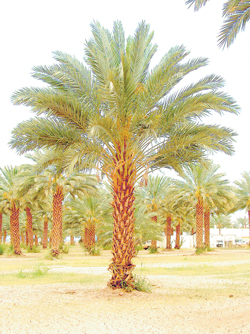 A Medjool date tree. California basically grows two main varieties of date — the Medjool and the Deglet Noor. The trees are also popular for landscaping.
In the 1990s, the popularity of the date palm as a landscape tool began to grow and reached a peak in the mid-2000s before the recession. Ryan explained that the going rate for a commercial acre of a date garden at the time was about $20,000. However, a grower could sell his trees — which would be uprooted and replanted — for $1,500 to $2,000 per tree. “He could get $40,000 to $80,000 for an acre of trees and keep the land.”
Needless to say, many trees were uprooted and date production waned. And some nurseries got into the business, not for the date production but just for the trees. Growers would replant the trees but with the landscape boom continuing, production didn’t catch back up. Fast forward to the housing crisis and all of a sudden, expensive landscape trees were not in great demand, and there was greater supply because of nurseries and others getting into the business of selling date trees. This has led to a revival of the date business as more commercial growers are concentrating on harvesting dates rather than trees.
Ryan said the industry is in a growth cycle as there have been many gardens planted in the past decade. Typically, a marketable crop isn’t harvested until about year seven in the growth cycle and peak production isn’t reached until year 12 or so.
California basically grows two main varieties of dates: the Medjool and the Deglet Noor. The Medjool is a larger, succulent date that makes up the vast majority of the fresh market crop. It is picked, packed and shipped in a moist state. The Deglet Noor is sold as more a dried product and used more often in processing, though it is also sold at retail, often as a date pellet. The Deglet Noor is called a “naturally dried fruit” as it is harvested at about 30-35 percent water content, which is far less than the 80-90 percent water content of most fruits.
In California, the Date Administrative Committee and the California Date Commission are industry organizations designed to regulate and promote Deglet Noor date production.
The Date Administrative Committee is funded by mandatory assessments of the handlers and promotes California dates in the United States through publicity of generic marketing, nutrition programs and product research.
The California Date Commission was established in 1996, under the California Food & Agriculture Code. It is also funded by mandatory assessment of the handlers, providing funding for pesticide and food-safety research.
The biggest promotional push is through education and information and includes recipe development and dissemination. There are dozens of recipes on the website of those organizations, which share a website at www.datesaregreat.com.
The website also touts the nutritional benefits of dates which are considered to be many, which is why they are a favorite in the foodservice arena.
Dates are rich in Polyphenols, a plant antioxidant that have a higher capacity of reducing oxidative stress. Polyphenols destroy free radicals that can cause disease. Dates can be used to naturally sweeten any dish with added sugars. They are a nutrient-dense food, high in dietary fiber, potassium and manganese. They also have a natural balance of other minerals including calcium, magnesium, zinc, copper, iron and selenium.