Pacific Northwest to harvest fourth-largest pear crop
Pacific Northwest to harvest fourth-largest pear crop
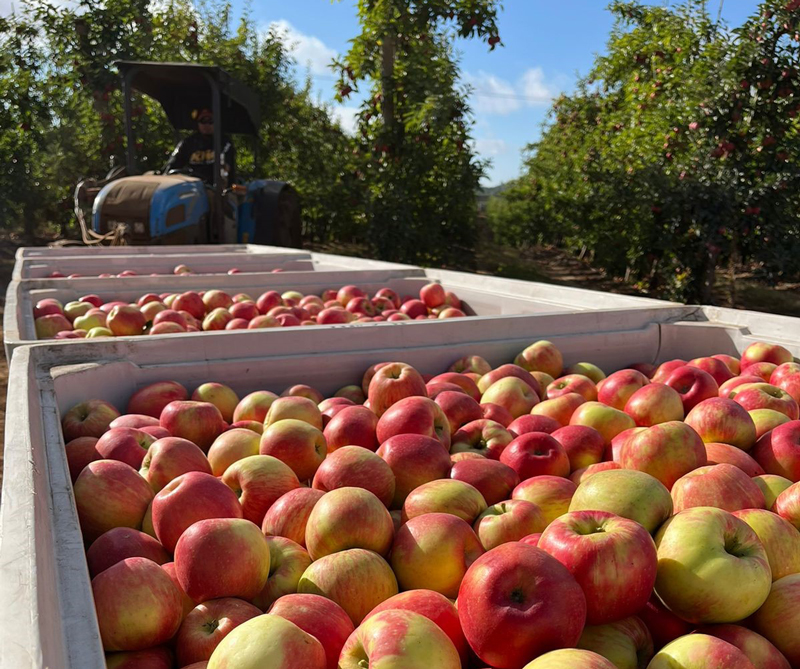
The Pacific Northwest is expecting to harvest its fourth-largest pear crop during the 2015-16 season. “The first estimates for the fresh pear crop show it coming in at just over 20 million standard box equivalents,” said Kevin Moffitt, president and chief executive officer of the Pear Bureau Northwest. “While this is 2 percent below last year, it is 2 percent above a five-year average and would make it our fourth largest crop historically. Last year was our second-highest pear crop on record, so with similar acres in production, a decrease is a fairly natural thing with tree fruit.”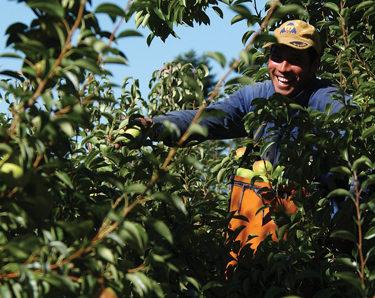 Pear growers in the Pacific Northwest experienced successive days of temperatures over 90 degrees. As a result, pear sizes are expected to be smaller this season. According to the Pear Bureau Northwest, consumers actively purchase the smaller-sized fruit. (Photo courtesy of the Pear Bureau Northwest)
The preliminary estimate was released in late May, and Moffitt said the numbers will be revised in mid- to late August.
“Our estimates are based on early fruit development observed in the fields,” he continued. “Most recently, the growing regions experienced successive dates over 90 degrees F which has impacted the size of our fruit. When the temperatures are in the 80s, we will see the size of the fruit increase. But over 90 degrees, the grower is working to keep the trees irrigated. The tree slows the fruit growth and at harvest time, the pears are often smaller than with more moderate temperatures. In recent years, we have seen some jumbo fruit — 70 to 80 pears per box.”
Although pear sizing may be smaller, Moffitt said this isn't necessarily bad news. “The good news is that consumers love the moderate-sized pear — 90 to 100 pears per box — and our shippers and packers will be able to meet the buyers' needs,” he said.
Initial feedback about quality is high. “Reports of fruit in the orchard are excellent,” Moffitt continued. “Our growers worked aggressively during the high heat periods to maintain the orchards. During the high heat, sunburn can damage fruit. But we are not hearing concerns about damage.”
Although there were no reports of orchard losses due to recent wildfires, Moffitt said some tree fruit storage facilities were lost. “There were some losses of stored pears, but with our collaborative tree fruit industry, other regional storage will be found to support those with a warehouse loss,” he said.
The total Northwest summer-fall pear volume is anticipated to be approximately 4.789 million boxes, down 6 percent from 2014. A breakdown by variety, approximate volume and decrease from 2014 revealed the following: Green Bartlett/4.373 million boxes, down 7 percent; Red Bartlett and other summer-fall pears/84,000 boxes, down 24 percent; and Starkrimson/331,500 boxes, up 5 percent.
The total Northwest winter pear volume is anticipated to be approximately 15.597 million boxes, unchanged from 2014. A breakdown by variety, approximate volume and increase/decrease from 2014 is as follows: Anjou/1 million boxes, down 4 percent; Bosc/3 million boxes, up 5 percent; Red Anjou/1 million boxes, down 8 percent; Comice/246,700 boxes, up 5 percent; Seckel/50,300 boxes, down 5 percent; Concorde/41,020 boxes, down 31 percent; Forelle/62,500 boxes, down 20 percent; and other winter pear varieties/36,850 boxes, down 23 percent.
Organic fresh pear volumes are included in the above estimates. Total organic pear production for summer-fall pear volume is 350,000 boxes. A total of 624,115 boxes of winter pears are expected to be produced. According to the report, the following volumes of organic fruit are expected to be produced this season: Green Bartlett/301,150 boxes; Red Bartlett and other summer-fall pears/27,000 boxes; Starkrimson/21,500 boxes; Anjou/377,000 boxes; Bosc/182,500 boxes; Comice/1,700 boxes; Red Anjou/48,500 boxes; Concorde/14,020 boxes; Taylors Gold/45 boxes; and Seckel/350 boxes.