Orange forecast revised for season
Orange forecast revised for season
On Jan. 12, the National Agricultural Statistics Service of the U.S. Department of Agriculture updated its national forecast for orange production. “The United States all orange forecast for the 2014-15 season is 6.72 million tons, down 3 percent from the previous forecast and down 1 percent from the 2013-14 final utilization,” NASS reported.
“The Florida all orange forecast, at 103 million boxes (4.64 million tons), is down 5 percent from the previous forecast and 2 percent from last season’s final utilization," the report continued. "Early, midseason, and Navel varieties in Florida are forecast at 48.0 million boxes (2.16 million tons), down 8 percent from the previous forecast and down 10 percent last season’s final utilization. The Florida Valencia orange forecast, at 55.0 million boxes (2.48 million tons), is down 2 percent from previous forecasts but up 7 percent from last season’s final utilization.”
Joel Nelsen, president of California Citrus Mutual, provided a snapshot of activity in the Golden State. The organization is a voluntary membership grower trade association representing over 70 percent of the industry.
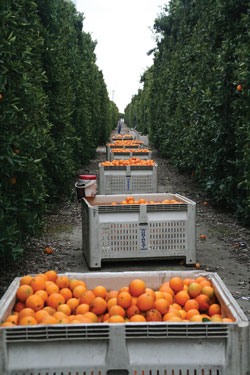 California producers grow citrus on 275,000 acres. Volume for the 2014-15 citrus crop will be smaller than the previous crop year. (Photo courtesy of California Citrus Mutual) “The primary citrus varieties grown in California are Navel oranges, lemons and Mandarin oranges,” he told The Produce News. “The next tier, in terms of volume, would be Valencia or summer oranges, grapefruit, Pomelos and other varieties.”
Nelsen said California has a total of 275,000 acres in production with another 10,000-12,000 acres being replanted.
He was asked how conditions have been during the growing season. “The weather, cold that is, has not affected quality or volume,” Nelsen replied. “We are a bit concerned about a constant flow of temps in the mid-60s as this cold could affect shelf life for fruit at the end of the season.”
He said this impact is yet to be determined. “We are not through with the winter,” Nelsen commented. “We don’t consider winter over until the end of February. So a lot can happen.”
According to Nelsen, volume for this season’s citrus crop will be less than the prior season. “That is primarily a function of growth, or lack thereof,” he explained.
“The December rains have positively impacted growth. But at the outset of the season, there were more small sizes than desired. This is due to two factors. One is Mother Nature, who will influence growth during critical spring and fall growth periods. The other is Mother Nature, who gave us less water than desired, thereby reducing the tree’s ability to provide growth spurts. The combination is not good from a consumer or producer perspective.”
California moves citrus fruit throughout the year. “The primary varieties during the winter are Navel oranges and Mandarins,” Nelsen stated. “The season starts in early October and can run to July 4 for Navels. Lemons move monthly but at varied volume levels.”
As of Jan. 1, NASS forecast that Texas was expected to produce 1.67 million utilized production boxes of early, mid - and Navel oranges during the 2014-15 season. Valencia production was set at 345,000 utilized production boxes. Grapefruit estimates for Texas were projected at 6 million utilized production boxes.
NASS reported that Arizona was anticipated to produce 220,000 utilized production boxes of tangerines and Mandarins.