Nogales distributors savor spring normalcy
Nogales distributors savor spring normalcy
NOGALES, AZ — There was no singular event — such as a hurricane or major freeze — that disrupted Mexican production this winter; however, the much-publicized vigor of El Niño managed to cause disruptions of cold and rain through the fall and early winter. The first sign of trouble came in late October, just as many leaders of the Mexican produce industry gathered in Atlanta for the Produce Marketing Association's Fresh Summit.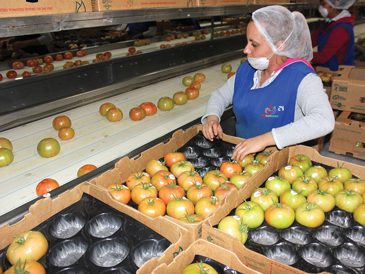 Tomatoes were generally scarce for North American markets this winter. These vine-ripe tray packs were being packed in early December at a Michoacán facility owned by Red Sun Farms.
What was a monster offshore hurricane — Hurricane Patricia — suddenly dissipated upon reaching Mexico’s southwest Pacific coast. For the overwhelming majority of the country’s growers, a first bullet was dodged.
But uncharacteristic weather, including clouds that slowed growth, was an ongoing challenge. Freezes between Christmas and New Year’s Eve were a particular setback for production in many fields. In January, supplies in Nogales were very scarce.
Jorge Quintero Jr., the managing partner of Grower Alliance LLC in Rio Rico said there was a 70 percent reduction in volume for some commodities.
Markets skyrocketed for most items like tomatoes, watermelons, squash and peppers. Not only were Mexican supplies scarce, but competitors in Central America, Florida and south Texas had their own production issues. Yuma, AZ, lettuce growers were set back by the cold. Meanwhile, on the East Coast record warm temperatures boosted shopping for fresh fruits and vegetables.
By late January, freezing was no longer a threat in west Mexico. Prices began to retreat and Nogales distributors geared for a return to normalcy.
Mike Righetti, the owner of Righetti Farms LLC, said in mid-January, “My gut tells me that when things get this bad, it’s gotta get better.” Righetti noted that the crops of Florida growers were so disrupted that Righetti Farms had gained some business shipping Mexican tomatoes to Florida.
“That’s what the winter program is all about. I am just glad that we did not have money in Mexico. We didn’t borrow millions to have sitting in the ground. It was one of those years that everyone kind of knew, with El Niño, it would be a wet year.”
“In general, everything was set back,” said Omar Losolla, director of sales and marketing for GreenPoint LLC, which is headquartered in Rio Rico. “The start of the new year was difficult for us in terms of supply. The weather has not been in our favor.” Northern Sinaloa and southern Sonora freezes at Christmastime “were pretty severe and hurt us on some product.” In January, “we are generally seeing increases in supply but it is nowhere near what we should have seen. The entire town [Nogales] is set back. It has been a challenge and difficult to fulfill all of our customers’ needs at this point.”
Losolla continued, “Having said that, the nature of the produce business is that it’s never a perfect scenario. It’s a challenging industry and that is the nature of the business. We are committed to supply our customer base the best we can.”
Bobby Astengo, a partner in Healthy Trends Produce Co. LLC, said Feb. 3 that the Bell pepper market had an unusually severe price adjustment coming off “epic prices” in January. More recently, “a correction has taken place and the market has rebounded to more normal price scenario.”
Green Bells “are keeping very high levels” in the $20s range for retail sizes. Foodservice green Bells were in the mid- to high teens, Astengo said. Mexico’s colored Bells were in the low to mid-teens in early February.