Netting, falcons help reduce blueberry crop losses for Rainier Fruit Co.
Netting, falcons help reduce blueberry crop losses for Rainier Fruit Co.
Rainier Fruit Co., headquartered in Yakima, WA, has undertaken two biological protection strategies designed to minimize blueberry crop losses attributed to wildlife.
“Organic and conventional producers alike deal with local birds and other wildlife feeding on their fruit when it matures,” Director of Marketing Suzanne Wolter told The Produce News.
“Many can lose a substantial amount of their crop to hungry birds,” she continued. “First, we completely enclosed our ranches in netting.”
The advantages of netting are two-fold. Wolter said the netting keeps birds out of the production area. Additionally, it provides a cooling effect by reducing the temperature inside the netted area upwards of 10 degrees.
“In the heat of the summer, this is extremely effective as central Washington temps frequently hit upper the upper 90s to low 100s,” she said.
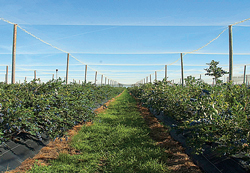 Rainier Fruit Co. employs two protection methods to minimize blueberry crop losses associated with birds and other wildlife. Production acreage is netted, with the dual effect of keeping birds out while lowering temperatures inside the netted areas. Predatory falcons are flown regularly around the ranch, discouraging other birds from nesting in the area. (Photo courtesy of Rainier Fruit Co.)Using the second protection method, Rainier has a trained falconer on staff and is raising predatory falcons in an aviary. Wolter said the predatory falcons “reduce the number of nesting birds near our ripening fruit. These predatory falcons are flown on a regular basis around the ranch. The local birds recognize a predator is in the area and will choose another location to raise their families.”
The company continues to emphasize organic blueberry production, and 90 percent of its volume falls into the category.
“Our climate, growing region and farming practices give us an advantage over other producing areas around the country to produce such consistent quality,” Wolter stated. “Many other regions face moisture and pest challenges. We grow ours in the desert so we don’t have moisture issues with which to contend. Since many other regions peak about the same time, we had to differentiate our product, and we’ve done that by providing a consistent organic supply throughout the entire summer and early fall. The fact that we grow all of our own blueberries gives us a unique advantage over many other brands because we control the entire process from farm to box.”
Weather has been conducive to blueberry production, and Wolter said production is underway. “The first blues have already been packed, and fruit is very clean,” she said. “Overall, we’re anticipating an excellent crop of beautifully sized and flavorful fruit — if the weather continues to cooperate.”
Although Rainier’s production acreage has remained constant, young bushes continue to increase productivity as they mature. “We expect to pack close to 7 million pounds, roughly 20 percent more than last year,” she said.
Blues are marketed under the “Rainier” brand to customers in the United States and Canada. Rainier does market some volume offshore.
This season, Rainier has expanded its line of peel-away recipe labels on blueberry packaging. “Last year, we had one recipe that we tested on two different sized clams,” she noted. “This year, we’ve added two more recipes which will appear on multiple packages beginning late June and into early August.”
On the social media side, Wolter said Rainier was pleased with the results of its “Show Us Your Blooms” contest, which ran throughout the month of May across multiple social media outlets. Participants submitted photos of anything in bloom, and Rainier’s Facebook, Twitter and Pinterest friends and followers voted for their favorites.
“The winner receives their choice of either a case of cherries or blueberries,” Wolter said.