Nature Fresh Farms to expand successful organic line
Nature Fresh Farms to expand successful organic line
Nature Fresh Farms recently added organic bell peppers to its product offering, and the line has been so successful, the company plans to double its current five-acre production next year. Nature Fresh is also doing trials for various types of tomatoes and will eventually branch out into cucumbers, zucchini and eggplant.
Chief Executive Officer Peter Quiring said the move was in response to customer demand. “We saw the growth in the category and it wasn’t slowing down. Organic does not seem to be a passing fad. Some of the retailers we deal with were asking for it.”
The company did its homework before adding the five new acres of organic production at its Leamington, ON, facility, conducting a year of research and trials in 2013. In addition to trying different varieties of peppers, Nature Fresh investigated different combinations of organic media to find its own recipe to grow effectively in glass structures.
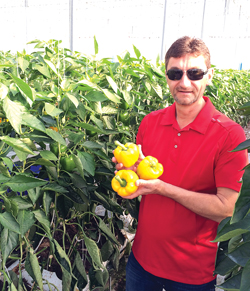 CEO Peter Quiring is impressed by the quality of the organic bell peppers the farm is producing.All of the preparation paid off. “We’ve got more demand than we have product. We’ve done a lot of marketing and advertising since starting down this organic avenue, and there’s been tremendous interest out there overall. We are not picking up the phone and asking people if they want to buy organic. They are coming to us,” said Business Development Director Ray Wowryk.
The company is marketing all four colors of sweet bell peppers, though most of the organic production is devoted to red. “I’m particularly impressed by the quality of the organic bells that we’re able to produce. When you look at them side by side, the organic to the conventional, it’s impossible to tell which one is organic. They look absolutely perfect,” noted Quiring. The peppers are marketed in a Stay Fresh bag to extend shelf life.
Organic production can be challenging, which means so far Nature Fresh does not have a lot of competition for its organic products. Organic growing methods require integrated pest management, which Nature Fresh fortunately was already using in its conventional farm. According to Quiring, the challenge is in finding the pests and pesticides used in organic farming. “We do spray in organic; it’s just organic sprays. The biggest challenge of all is finding nutrients that are certified for organic.”
The company had to invest in changes to its equipment and facilities as well. “Not only did we have to modify the greenhouses, we had to create a whole separate automated packing facility to handle our products. We needed a whole new team of packers and supervisors to manage that aspect of our business. It’s extremely important to keep the organic farming separate from our conventional operation to maintain certification,” said Wowryk.
Quiring noted Nature Fresh’s relationship with sister company South Essex Fabricating gives it a competitive advantage in greenhouse design. “As we expand into the U.S., we will engineer the structure with organic in mind from day one.”
The company has found there are particular challenges as a Canadian grower. Although Nature Fresh’s major market is the U.S. Eastern Seaboard, Canadian Food Inspection Agency regulations do not allow the farm to bring offshore organic product into Canada to ship to the U.S. to make up a shortfall. Quiring’s strategy is to expand in both the United States and Canada to meet demand.
Nature Fresh brought a mini-greenhouse for display to United Fresh 2014, complete with tomatoes and growers on hand to talk about organic production methods. “Not everyone has the opportunity to come out to a greenhouse to see how this process takes place,” said Quiring. “So we built a greenhouse to take it to the buyers.”