National Honeycrisp production may double in five years
National Honeycrisp production may double in five years
SPARTA, MI — It has been 20 years since Riveridge Produce Marketing Inc. planted its first Honeycrisp apples. Don Armock, the owner of Riveridge, said the variety’s production still hasn’t caught up with consumer demand.
Vast newer plantings of Honeycrisp are in production or are increasingly productive each season, Armock said.
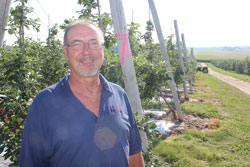 Rick Zemaitis, the quality assurance manager of Riveridge Produce Marketing Inc., stands in one of the Sparta, MI, Honeycrisp plantings of the grower-packer-shipper. “As long as the industry does the right job delivering Honeycrisp to meet consumer expectations, Honeycrisp sales will continue to grow dramatically,” Armock said. Honeycrisp currently ranks fifth among apple varieties, and before many years “it will be one of the top three in the apple category. What has happened is that it has captured the imagination of consumers and retailers. It has brought major profits to retailers and growers. We are trying to learn storage techniques for the long haul. It has been a fall and early winter apple. I suspect that it eventually will be shipped year-round. Every year is a record year and, similar to Gala, every year it is marketed easily.”
In 2014, the United States produced almost 8.5 million bushels of Honeycrisp. “Within the next five years, it is entirely possible to double that production,” with a national crop of 15 million — or even 18 million — bushels of Honeycrisp, he said.
While retailers and customers may love the variety, growers and packers endure a lot of technical challenges to get the fruit off the tree, through packing and storage and to the retail shelf.
“There are a lot of issues that affect pack out,” Armock said. The trees are biannual bearers, which means that every other year tends to have a large crop. The apples are prone to bitter pit, internal browning and two types of storage scald. Riveridge and other sophisticated apple packers use infrared technology to grade out the internal defects.
Honeycrisp apples do not reach maturity on the same tree at the same time, requiring pickers to go through an orchard on three or four occasions. And in that harvest process, the workers must “stem clip” the Honeycrisp. This involves clipping the stems at harvest rather than simply pulling the apple off the tree. The clipping is done below the apple’s shoulders so longer stems won’t puncture the fruit in subsequent postharvest handling processing.
Because of the slow stem clipping process, workers are paid a 30 percent harvest bonus for Honeycrisp.
Because the margins are there, “we can afford” to produce, pack and ship Honeycrisp, despite the extra costs, Armock said.