M. Levin & Co.’s banana ripening rooms are booming
M. Levin & Co.’s banana ripening rooms are booming
“Our state-of-the-art banana ripening rooms here at the new Philadelphia Wholesale Produce Market employ the latest technology,” said Mark Levin, chief executive officer of M. Levin & Co. Inc. “They are getting a real workout because as fast as we fill them, they’re emptied again.”
M. Levin & Co. moved to the new market when it first opened in June 2011. The company occupies four units, H-2 to H-5. It is ripening about 35,000 boxes of bananas per week. The entire facility was built with the latest technology that focuses specifically on fresh produce. Mr. Levin said that new business doors have swung open to the company since it moved to the new terminal.
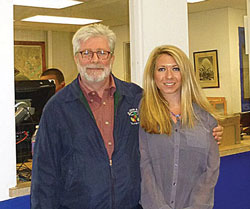 Mark Levin, chief executive officer, with his daughter, Tracie Levin, general manager responsible for operations management and food safety of M. Levin & Co. Inc. “Things are moving smoothly, and the facility is a joy to work in,” said Mr. Levin. “Just look around you. This facility is clean, efficient and safe. Everyone — workers, customers and visitors alike — are all smiling. Our customers are happy and our business continues to grow with the fourth generation of all women helping to move us forward.”
M. Levin has a long history in the produce industry. It was established in 1906, and today it handles a full line of fresh fruits and vegetables. Besides its large banana and conventional lines, the company also offers a full line of tropical produce. The company provides all services including packaging, rail car access, retail promotions and delivery in the Mid-Atlantic region.
The generational family business is also a special story. Mr. Levin is a third-generation family member, and he works side-by-side with his cousins, David Levin, Michael Levin and Joel Segel.
“Throughout every generation, including mine, there have been only men in the business,” said Mr. Levin. “But now the fourth generation has joined the firm, and it is all women. Tracie Levin, my daughter, is the general manager responsible for operations management and food safety among other initiatives. Sarah Levin, David’s daughter, is involved in our banana ripening program. Margie Levin-Fischman, Michael’s daughter, is in tropical sales and foodservice, and Brenda Segel, Joel’s daughter, is in inventory control. From four male cousins in my generation, we’re moving to four female cousins in the next generation.”
M. Levin & Co. sources from around the world, and it distributes from Virginia to Toronto and west to Ohio. Mr. Levin said the company also ships some produce into New York City.
“We plan to branch out to Puerto Rico and the U.S. Virgin Islands in the near future,” Mr. Levin noted. “These U.S. territories are less tedious to work with than foreign Caribbean islands. The money is a little safer and easier to collect. Horizon Lines, a major shipping operation, loads the containers. They were previously shipping out or Port Elizabeth in New Jersey, but it has moved to our local pier in Philadelphia. With Horizon Lines now right around the corner, it makes us much more competitive.”
Mr. Levin acknowledged that the demand for locally grown continues to increase, especially in the summer when the Northeast is reaping its typical high-quality and strong volumes of fresh produce.
“But we’re also up against backyard gardens today,” he noted. “One small garden can feed a block of people. But that also speaks to how people are getting back to the earth and growing their own food, and that is a great thing.”
M. Levin is focusing on peaches produced in the eastern United States. He said that when the quality and volumes are as great as they are in eastern states, he simply does not want them from California.
“This is a mentality issue,” he said. “People have it in their heads that California fruit is better, but it’s not. And there is no way it can be fresher than what producers in the east can provide.”
There is sincerity in Mr. Levin’s voice when he talks about how every day brings new questions and challenges, and the future of businesses like his depends on responding to those issues in the right way.
“It’s also about working with the new generation to teach them as much as possible,” he added. “I remember being my daughter’s age and working for my father in the business. I would suggest something to him and he would look at me like I was crazy. I guess that’s totally normal with every new generation. I tell our girls that there is nothing better than putting your face out there and meeting people one-to-one. My generation can teach them everything they need to know about the produce business, but we can’t teach them how to be personable. And that’s the most important part of being in this business.”