Johnston Farms finds Satsuma popularity growing due to high flavor
Johnston Farms finds Satsuma popularity growing due to high flavor
Johnston Farms in Edison, CA, which grows several varieties of Mandarins in addition to Navel oranges, packed mainly under the company’s “Blue Jay” brand, is finding that its Satsuma Mandarins are continuing to grow in popularity.
Dennis Johnston, a partner in the company, attributes that growing popularity to the high flavor of the variety.
Next to Navels, “our biggest crop is Satsumas,” he said. “Everybody talks about Clementines and ‘Cuties’ and now ‘Halos.’ But the Satsuma keeps plodding along. I think the people that want the high flavor tend to migrate to the Satsuma.”
The company expected to start Satsumas about two weeks before Thanksgiving. They will run through about the end of January.
In addition to the Satsumas, Johnston Farms grows and packs W. Murcotts, which start around the end of January, as well as Tahoe Gold Mandarins and Gold Nugget Mandarins that come later in the season.
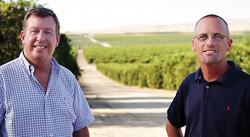 Dennis Johnston and Kevin Johnston at one of the Johnston Farms orchards. (Photo courtesy of Johnston Farms)On all of the Mandarin varieties, “our deal is still 100 percent stem-and leaf,” Johnston said. “That started out as a tradition in the Oriental markets, but we are finding everybody likes it. Number one, it forces the stores to keep their inventories fresh.” If the Mandarins have “old wrinkled up brown leaves, people tend to know they are a little older, where if they have a fresh green leaf on them” consumers know the product is still fresh. That motivates the store’s produce team to “keep inventories tighter and move through them faster.”
Other packers do stem-and-leaf Satsumas as well, “but they haven’t focused on it the way we have,” Johnston said. “We do about 200,000 boxes of Satsumas” each season, and “it is all stem-and-leaf.
In the Mandarin deal, Johnston Farms continues to increase its production, “but slowly,” Johnston said. “Ten to 20 acres a year is about the increase in the Mandarin deal for us.” That much acreage is “but a blip” on the radar for some of the larger Mandarin growing operations in the state. “But it works for us.”
About 50 percent of the company’s Mandarins come from its own ranches, and the rest come from outside growers spread throughout the southern and central San Joaquin Valley to as far north as Orange Cove. “There are a lot of growers that have 10 acres of Mandarins and that’s it,” he said. It may be just “in the corner of a Navel block. We have a lot of growers that we take care of,” and most of them have around 10 acres.
Navels are Johnston Farms’ biggest citrus crop, and those are another matter. In the Navel deal, “90 percent is our own” production, Johnston said. “All of our Navels come out of the Edison area.”
The company is also increasing its Navel production. “We are increasing our late season varieties here,” he said. “There continues to be a good market in the later windows — April, May, June,” particularly for export markets looking for “a high-quality piece of fruit. So we are planting later season [Navel varieties] to have high- quality fruit for them.”
The company expected to begin packing Navels around Oct. 28, “and that, for us, is about a week early,” said Johnston, noting that some other growers were already picking and packing.
“In the Navels, we continue to upgrade equipment as needed” in the packinghouse, Johnston said. Fox bags, which are half mesh and half poly, are “catching on,” so the company has bought machinery “to handle that.” The new machines “can pack practically any bag known to man,” he said.
On sales at Johnston Farms are Harley Phillips as well as Johnston’s two nephews, Derek and Cameron Vaughn, who were already with the company and were moved into sales about a year ago. They are “learning the trade,” he said.