Jasmine’s summer and fall grape programs span wide range of varieties
Jasmine’s summer and fall grape programs span wide range of varieties
From early season Flames to late season Autumn Kings, Jasmine Vineyards Inc. in Delano, CA, offers a broad assortment of fresh grape varieties, grown in the Delano district.
“Thus far, we just started with Flames. It’s the only variety I am currently doing,” said salesman Brian Crettol in an interview with The Produce News July 9. “We are going to start some Princess and some Summer Royals here probably toward the end of this week.”
Jasmine started harvesting Flames on June 30, which is “early for us,” Crettol said. “Normally we don’t start until the second week of July.”
So far, “the market seems to be good and prices are holding up nicely,” he said.
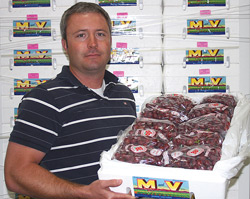 Brian CrettolAmong the varieties offered by Jasmine during the course of the season are Sweet Sunshine, a proprietary green seedless variety, and Sweet Celebration, a proprietary red seedless variety, Crettol said. The quality looks good on those, and they should have good crops, Crettol said. “There is a lot of fruit out there,” he added.
Crettol expected to start the Sweet Sunshine harvest late July or early August. “We will have plenty of those” along with “all the regular varieties,” he said. “Later in the fall, we are going to have our Scarlet Royal, our Vintage Red, and our Crimson. We’ve got [Red] Globes for the Chinese market. We’ve got Autumn Royals.”
Jasmine also has “a lot of Autumn Kings,” he said. “That is our big fall variety.”
The company has increased acreage of Autumn Kings, and also of Autumn Royals, in production this year, he said.
Jasmine Vineyards’ production is heavy to the later season varieties, Crettol said. “We are not so much tailored to the front end of the deal. We are more of a late grape grower. That is why we don’t have anything in Arvin,” traditionally the earliest district in the San Joaquin Valley, “or in Coachella,” which precedes the Arvin deal.
Many of the newer varieties coming out of various public and private breeding programs “tend to be later varieties,” he commented.
On the early side, “I wish there was a variety we could replace Flames with, because they are labor intensive” and expensive to grow, and “they don’t have huge crops,” Crettol said. “I talk to all the breeding guys” and “they are all working on something to take the place of Flames, but thus far they have been unsuccessful.”
For the mid and late season, however, the company continues planting some of the newer varieties. One of those is a mid-season green seedless variety called Great Green, “which comes off about the same time as Thompson,” he said. “We are transitioning out of the Thompson business. The Thompsons are an old variety, and it is being replaced by better-producing, improved varieties, Great Green being one of them.”