Hot vegetable markets usher in the new year
Hot vegetable markets usher in the new year
The first supply outlook newsletter of 2016 for Tanimura & Antle reflected on 2015 and noted that the “phrase that sums the year up the best is ‘demand exceeds supply’.” For the next few weeks, and maybe even for the next several months, that could continue to be an apt description.
Although the T&A newsletter (released on Jan. 4) indicated that there could be a loosening up of supplies by the third week in January, wet weather hit the desert areas of California and Arizona the week of Jan. 4, and forecasters said storms were lined up in the Pacific waiting their turn to drench the West Coast. 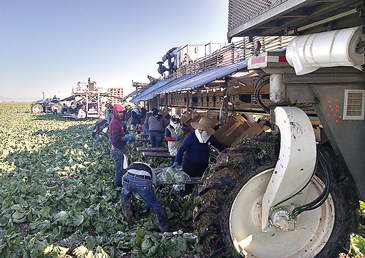 Skies were blue during the last week of December for the lettuce harvest in the California desert, but for the new year, several days of rain made it difficult to get into the fields, causing f.o.b prices to spike again.
J.P. LaBrucherie of LaBrucherie Produce LLC in El Centro, CA, was surveying his fields as he spoke to The Produce News Jan. 6, and he didn’t note the type of growth in the fields that would mean increased supplies in the coming weeks.
“I don’t see that out there,” he said, adding that warm weather could change the situation, but doesn’t he believe the current market dynamic appears to be ripe for change. “It all depends on the weather. The rain makes it sloppy out there and difficult to get into the fields. We have been hit with a series of problems, starting with the extreme heat in September, which have affected supplies.”
Doug Classen, sales manager for The Nunes Co. Inc., headquartered in Salinas, CA, had a similar take. “The weather will have an effect. If cold follows this rain, it is going to slow down the growth again.”
Classen said the winter vegetable deal got off to a slow start and the fields just haven’t caught up. Moving forward, he expects short supplies to be persistent, but item-specific.
For the next several weeks, Classen believes celery and Iceberg lettuce will remain in a demand-exceeds-supply situation, while Romaine and some of the mixed lettuces could well see an increase in supply. But like everyone else, he said the weather will be the determining factor.
Speaking of the El Niño storms expected throughout the next several months, he said there will be both short- and long-term effects. In the Salinas Valley, growers have started planting for the spring harvest, but Classen said this week’s rain has already put them behind schedule. Every day that rain prevents planting could mean less production down the road when those crops were slated to be harvested. It is all very scientific these days, with each day of planting forecasted to fill a specific demand slot down the road.
Pete Georgalos, quality manager for Iceberg lettuce for D’Arrigo Bros. Co. of California, based in Salinas, agreed with the others that the winter vegetable deal is very weather-dependent this year, and he expects the current strong market to continue for quite some time.
Georgalos said the Iceberg lettuce market dipped from the mid $30s to the low $20s during the week between Christmas and New Years because of light demand.
“But this week, we saw the demand come back and the market rose to $28-$30 today,” he said Jan. 5. “If we get a half-inch of rain [in the desert] like they are predicting, we will be out of business [for that day] and the market will continue to rise.”
Taking a broader view, Georgalos said it appears that it is difficult for western vegetable suppliers to keep up with demand, regardless of the situation.
“I can’t remember the last time we had a low market. Even the dog days of August are no longer dog days,” he said, noting that strong markets accompanied the vegetable deal all summer.
He said weather and other issues have disrupted production over the past couple of years, but not seemingly enough to explain the very good markets that have persisted for most of the last two years. “Our production numbers haven’t changed, yet we are seeing much better markets.”
Georgalos allowed that some acreage might have shifted from vegetables to strawberries over the last couple of years, but he is still a bit perplexed as to why the industry has experienced an unprecedented string of good markets. He said he can’t remember the last time the lettuce market dipped below double-digits.
Classen of Nunes was a bit more reserved in his analysis of 2015. He said the hottest summer for many years in the Salinas Valley combined with other disruptions in 2015 to create a “very good year” marketwise. “But I wouldn’t call it a banner year, at least not one that we haven’t seen before.”
He indicated that the many disruptions led to uncertainty in the marketplace, which resulted in a consistently strong f.o.b. price.
Speaking specifically of the winter vegetable deal, LaBrucherie said the 2015-16 year is shaping up to be a very good one for growers with regard to the market price.
“We don’t see this situation often, but about once every five to seven years it happens,” said Classen. “We started out with a good market and we still have it.”