In the Trenches: The unprofitable and senseless banana price mess
In the Trenches: The unprofitable and senseless banana price mess

Isn’t it time to end the 40-year banana price war?
Produce directors warn senior leadership that banana retails must increase because the fruit is being sold below cost, generating a negative gross profit. Executives refuse to act, choosing instead to absorb millions of dollars in losses.
This decision doesn’t just cripple the company’s bottom line — it undermines the very farmers whose livelihoods depend on receiving a fair return for the bananas they grow.
A creative banana pricing strategy to draw customers into the store has been copied so often that every supermarket chain has the same banana price program and no one has an advantage.
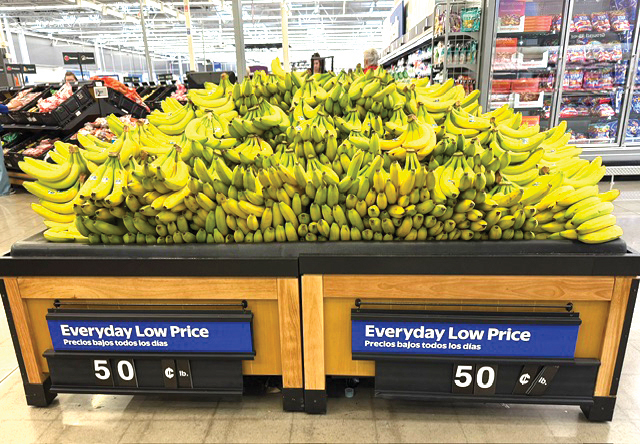
Banana prices remain stuck in a 1980-time warp, outlasting every modern advancement like computers, phones, cars, clothing trends and more than 40 years of inflation. Yet the grocery industry keeps pretending this is sustainable. Companies can’t keep playing the same old pricing game with a strategy that’s been worn out for decades. To gain any real advantage, they must challenge outdated thinking and finally break free from the petrified banana price mindset.
 Food prices rose by 2.3 percent in 2024 and 2.9 percent in 2025. Prices for all food are predicted to increase 3.4 percent in 2026. Prices for fresh vegetables at retail stores are predicted to increase 7.8 percent in 2026. Prices for fresh fruits are predicted to increase 1.8 percent in 2026 — except for bananas.
If retail banana prices had matched general economic inflation, they would be priced around $1.38 per pound today. Instead, the real-world retail price sits at just 65 cents per pound.
Produce retailers are used to experiencing 40 percent gross profit. Most operators are earning a top line profit on bananas of just 10 to 12 percent — if they’re lucky. Many others are selling bananas below their cost level. That does not include the shrink, which can be up to 8 percent as a result of its delicate structure, low shelf life and customer handling. Is that insane or what?
Produce directors are stranded in the middle of this banana pricing trap as it eats away at their gross profit. One director revealed that it is an everyday loss in their produce departments. He added that not only are bananas a loss leader, but they are also a shrink loss leader.
“It is a very challenging commodity for the 40 years I’ve been doing this,” said Vince Mastromauro, director of produce operations for Sunset Foods based in Highland Park, IL. “There was a time, years back, when we were bouncing around between an everyday retail of 59 cents per pound and then 69 cents, but this lowball pricing doesn’t cut it if you’re trying to achieve the budget expectations, especially when adding in the shrink loss.
“I personally think there’s room to elevate the retail, especially since my cost is being increased,” Mastromauro continued, “but I feel when the retail goes beyond 99 cents, it could be pushed back in reverse. So, the game plan is to have a discussion with management because the price of bananas is such a sensitive commodity. No matter what you price bananas, a customer will still only buy one bunch.”
If growers can’t afford to operate under the current costs, the entire banana-growing industry will decline in quality and volume creating supply shortages. This ongoing dilemma is not just about the retail price — it’s about averting a banana supply crisis.
“This is a critical time to begin a real discussion with retailers about reinvestment in the banana supply chain,” said Tom Stenzel, managing director for the Banana Association of North America. “From growers to distributors, the banana supply chain is stressed by huge disease pressure, extreme weather patterns from climate change, exorbitant fertilizer costs, ocean shipping that has doubled in price, land-based fuel delivery costs and now a new serious emerging threat of El Nino. There is no longer a sustainable banana supply chain without investment to deal with these challenges.
“Retail prices of bananas are lower than 40 years ago, based on inflation,” Stenzel continued, “but the increasing productivity that has allowed low prices is now actually decreasing productivity. There’s been almost a mythology among retailers keeping loss-leader banana prices. Consumer research and actual buying patterns have shown consumers are not as price sensitive as the mythology. When every other fruit or vegetable in the produce department has required increases to sustain production, it’s simply no longer tenable not to invest in the banana supply chain. Retailers set prices, and they can always choose to price bananas however they want, but if retailers — and their customers — are to enjoy continued access to their favorite fruit, they simply must invest more in a sustainable supply chain.”
So, how do retailers emerge from these years of the banana pricing hang-up? There is a stubbornness to raise prices. This is a very difficult task to accomplish due to such an unyielding competitive stance. It’s probably going to take a major retailer to step outside of the box and gradually increase the banana retail at an interval frequency until it reaches a more profitable level. The biggest question, which retailer will be willing to transform the shoppers?
Retailers don’t break out of a decades long pricing freeze by accident. They do it when the profit pain of staying stuck finally outweighs the fear of moving first. Bananas are the perfect example of a category where everyone knows the price is illogical, but no one wants to be the first to make a move.
Here’s the real dynamic at play, and why the stalemate banana pricing fiasco eventually cracks. For years, retailers treated bananas as a loss leader identity item and a psychological eye-catching price, but today’s economics have changed.
- Production costs have risen dramatically
- Farm closures are increasing
- Supply is tightening
- Retail margins are now embarrassingly out of sync with every other produce item
At some point, the math just won’t work. Retailers can’t keep absorbing the hit forever. The pricing breakthrough won’t be a sudden jump. It will be a controlled, incremental retail rise, spaced out over months, so shoppers barely feel it.
A major retailer with skill, confidence and strong customer loyalty will eventually admit that they can’t keep selling bananas at 1980 prices.
They will bump up the retail in small, steady steps until it reaches a sustainable level.
Once the big player makes the move, the rest will follow. Most retailers hate being first, but they hate being last even more.
Bananas are the top produce sales-generating sales item, yet they generate no profit for the retail companies or the farmers who grow them. It’s time to end this absurd and senseless price war before it turns into a serious declining supply shortage crisis.
What do you think? Write to me at [email protected]
Ron Pelger is a former director of produce merchandising and procurement for a major supermarket retail chain. He is currently a free-lance writer for the produce industry supporting growers, shippers, and retailers. He can be contacted at 775-843-2394 or by e-mail at [email protected].