Grupo Molina excelling at all phases of grape production and marketing
Grupo Molina excelling at all phases of grape production and marketing
PESQUEIRA, SONORA — An idyllic breeze cooled the shaded veranda of the bright-white hacienda of Agropecuaria Las Mercedes, a 1,200-acre vineyard.
There, 42-year-old Javier Molina Jr. explained that in 1979, Las Mercedes was the first table grape vineyard created by his father, Javier Molina Sr., and uncle, Marco Molina Sr., who is the new president of AALPUM, the Sonora Grape Growers Association. 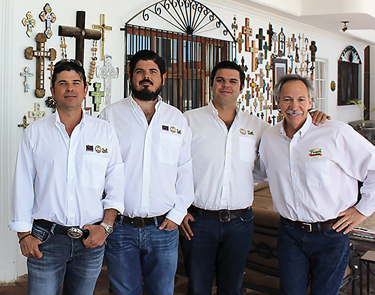 At the Pesqueira, Sonora, hacienda of Grupo Molina are Javier Molina Jr., Juan Pablo Molina, Marco Molina Jr. and Jerry Havel. Havel, director of sales and marketing for Fresh Farms in Rio Rico, AZ, opened Fresh Farms nine years ago with the Molina family, which created the marketing firm.
Sitting in the pleasant shade April 23 with Javier, who is the firm’s general manager, were his brother, Juan Pablo Molina, and their cousin, Marco Molina Jr.
Also enjoying the ambiance was Jerry Havel, who directs sales and marketing for Grupo Molina’s Mexican products via Fresh Farms in Rio Rico, AZ. Havel created Fresh Farms with the Molinas nine years ago, and this year the firm will export almost 3 million boxes of grapes.
In 2004, the Molinas purchased what is today the 800-acre Agropecuaria La Navidad vineyard in the La Costa Norte region.
Agropecuaria Don Roberto was purchased in the La Costa region in 2007 and now it has 480 acres of grapes. Agropecuaria Santa Maria, near to Guaymas, was planted in grapes in 2009 and now has 860 acres.
Grupo Molina also owns 375 acres of grape production in California. This provides the firm with summer grape volume when the two-month Mexican deal winds down in late June. The California deal works through Visalia Produce in Kingsburg, CA, which was purchased by the Molina family four years ago. Visalia Produce also markets some of Molina’s Mexican grapes.
Prime is a green seedless variety that is predominant for Grupo Molina, which pays royalties to an Israeli company for production rights. Grupo Molina is part of the grape variety development clubs International Fruit Genetics in Bakersfield, CA, and Sheehan Genetics in Porterville, CA. The firm also works with grape breeders in Spain and Israel.
“We are very focused on flavor,” said Javier Molina Jr. “There are a lot of wonderful varieties and wonderful flavors.” This year Molina will have very limited volumes of IFG’s Cotton Candy variety grapes, which will be shipped in June.
Sweet Celebration is another relatively new flavorful variety that is being increasingly produced. Sweet Celebration is a red seedless, which comes onto the market after Flame.
Sweet Globe, a large, green, crunchy variety from IFG, is also coming into commercial production. The firm is currently testing 100 new varieties to check performance on its properties.
Juan Pablo Molina, who is the general manager of Fresh Farms’ office in Rio Rico, noted, “We are focused on growing quality grapes, so we focus our extra effort on this.”
About half of Molina’s grapes are green and about one-third are reds. Ten percent are seeded and are sold primarily in Asia. The remainder of the grape varieties are black or in the new, especially flavorful category.
Shade cloth stretched over vineyards reduces the plants’ water consumption by 25 percent. This is critically important because water use rights are very limited in this area. Saving 25 percent of water use in one vineyard leaves open the opportunity to expand production nearby. Javier said that shade over the vineyard cuts out the hot sun and reduces the need for fertilizer. The end result of vineyard shading “is much better quality and it works much better for the environment.”
Grupo Molina and Fresh Farms export to the United States and Canada predominantly. Other foreign markets are China, Japan, Singapore, Indonesia, New Zealand, the United Kingdom, Costa Rica and Puerto Rico. Next year the firm hopes to add South Korea and possibly others to its list.
In Guaymas, in addition to grapes, Grupo Molina produces 125 acres of shadehouse cucumbers, with production running from October through April. That production will soon be doubling with a variety of squash, as well as cucumbers, in the coming mix. The company also grows watermelons in the Guaymas and Empalme area.
Juan Pablo Molina, added, “We are vertically integrated, from the farm, cold storages in Mexico, trucks, cold storage in Nogales and two distributing channels for our grapes, all of this with 100 percent traceability.”
He noted that Grupo Molina’s operations are based on the premise that the company can’t succeed without people to do good work.
To benefit workers, Molina ranches have fresh bakeries, recreation centers with soccer, basketball and volleyball courts. Soccer tournaments will draw 300 fans per game.
Grupo Molina provides three meals a day for its employees, as well as medical care, coin laundries and other benefits. The workers have come to appreciate the advantages of being paid through ATM machines, which are on each farm. Every week the employees receive a questionnaire asking for critiques of meals and other such matters.
“The future of this business is water and having the right people,” said Juan Pablo Molina, noting that the people will come back to work if they are treated well.
Havel said, “Grupo Molina is one of the first to plant grapes in Mexico and is now in the second generation. They have put themselves in the position to be one of the largest in table grapes.”
Grupo Molina has focused on social responsibility, food safety and production, harvest and postharvest practices to maximize quality and shelf life, while tapping global resources to assure production of the best grape varieties.
“They have been very successful,” said Havel. “And the family puts a lot of money back in the farms every year to be productive, using the latest technology to improve quality for the consumer. I’d put these vineyards up against the standards of any vineyards in the world.”