F.H. Dicks, Melon 1 hope for better watermelon year in 2015
F.H. Dicks, Melon 1 hope for better watermelon year in 2015
BARNWELL, SC — In 2013, heavy rains and flooding hit at harvest time, making many fields impossible to harvest. In 2014, planting was delayed by wet and cold conditions and the crop matured late, causing a shortage for the July 4 market and an oversupply after the holiday.
“We hope 2015 will be a better year for the farm,” said F.H. (Hammy) Dicks IV, who partners with his father, F.H. (Hamilton) Dicks III, in F.H. Dicks Co. and Melon 1, Inc. The Dicks family has been growing watermelons for three generations and understands that farming is a risky business. “Our window in the market is June 15 to July 15, but we hope to have most of our 250 acres of seedless watermelon in Barnwell picked by July 1,” Dicks noted. The demand for watermelon and the price is always better before the July 4 holiday.
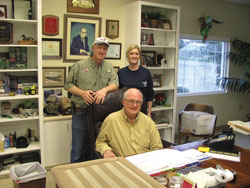 F.H. Dicks Co. Inc. operating partners are F.H. (Hamilton) Dicks III (seated) and F.H. (Hammy) Dicks IV. Office manager and head of Sprout Inc., the greenhouse division, is Allison Dicks Forehand.Labor supply has been sufficient, water for irrigation is not yet a problem, weather has been good and the Barnwell fields were mainly planted at mid-April. “We anticipate a good crop this year, and we expect to ship 350 to 400 truckloads of watermelons,” Dicks added.
F.H. Dicks Co. is a partner in Melon 1 Inc., a leading East Coast watermelon shipper. The partnership was formed in the 1990s by Dicks; Lawrence J. Lapide in Brooklyn, NY; and Richard Chastain Melon Sales in Fort Myers, FL. Melon 1 Inc. packs and ships 8,000 truckloads of watermelons annually.
Major changes Dicks and his father have noted in the watermelon industry are the rise of chainstores and clubs as key melon retailers, and consumer demand for smaller and seedless melons. “Most watermelons sold today are bought by supermarket shoppers,” Hammy Dicks estimated. “Roadside stands and farmers’ markets continue to be a vehicle, but today it’s supermarkets.”
In the last decade, the seedless watermelon has become a consumer favorite, he remarked, estimating that 90 percent of sales are seedless. “And that’s good,” Dicks observed. “The old seeded melons had a shelf life of five to 10 days; seedless varieties have a shelf life of two to three weeks.” Personal-size melons, ranging from five to eight pounds, continue to grow in demand.
In the Barnwell fields, watermelon seedlings were transplanted by hand into plastic mulch on April 7. In the past, Dicks observed, workers sat on the back of a transplanter pulled by a slowly moving tractor. “We found that we prefer to transplant in the field by hand,” he recounted. “The tractor method sometimes caused workers to miss a hole because it just went by too fast.”
A metal-roofed shed with wires and hoses snaking from it was the computerized irrigation center, which controls the supply of water and fertilizer to the watermelon transplants through a drip irrigation system. In the fields, strips of rye grass planted the previous fall grow tall to provide protection from the wind and sand. An electric fence keeps deer at bay.
F.H. Dicks owns or leases the land and works with local farmers who grow crops like cotton, soybeans, peanuts, corn and other grass crops to allow healthy crop rotation in the fields. “By next year, I hope to have enough land to grow watermelons in each field every fifth year, rotating other crops to restore the land,” Dicks said. A subsidiary greenhouse operation called Sprout Inc. grows the watermelon seedlings planted by F.H. Dicks Co.
How can supermarkets sell more watermelon? Hammy Dicks had a ready answer: “Consumer research shows customers, who have a good experience with a quality product, come back for more,” he stated. “Offer sweet, ripe watermelons with consistent quality and customers will come back for more.”