Drought conditions persist in Colorado
Drought conditions persist in Colorado
Colorado State Engineer Dick Wolfe said officials continue to monitor Colorado snowpack and water levels. “In general, the reservoirs are in good shape,” he told The Produce News in mid-April. “But drought conditions still persist. We started into the winter with good snowpack. Then things dropped off in February.”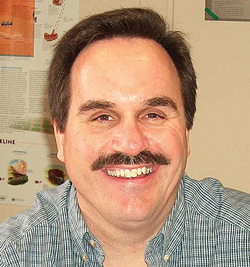 Dick Wolfe
Alpine areas are still showing good snowpack, he went on to say. A winter storm, which was termed “significant” by the National Weather Service, began pushing its way into the Centennial State on April 16. “We’ll see what happens with the coming storm this week,” he commented.
Looking ahead, he added, “The long-term forecast is showing above-average precipitation.”
It is too soon to assess the dynamics of snowmelt in Colorado. Settling dust can be a factor in accelerated snowmelt. This becomes evident when dust events occur in desert regions, and the blowing dust settles on snowpack in Colorado’s high country. The dust darkens the surface of the snow, thereby absorbing the sun’s rays, speeding up the melting process.
“It’s not necessarily from fires,” said Wolfe about the dust.
Farmers in southern Colorado continue to feel the drought’s pinch, with Wolfe saying that the Rio Grande River Basin is currently below 50 percent of average volume. “This is typical for Rio Grande,” he noted, saying that the area has experienced only three years of above-average moisture in the past 15 years. “[Agricultural producers] have become accustomed to these type of conditions.”
The state of Colorado continues to work with six other basin states that are part of the Colorado River Compact. Colorado, part of the upper basin, retains rights to 51 percent of water allocation. The other states in the upper basin are Wyoming, New Mexico and Utah. The lower basin states are California, Arizona and Nevada.
“Both of those are in play as the law of the river,” said Wolfe of the agreements executed in 1922 and 1948. “Colorado is in compliance.”
California retains the largest water allocation for lower basin entities. In addition to water from the Colorado River, Wolfe said California retains water rights in two other supply lines.
“They’ve got a pretty difficult water situation going on there,” he said. “There is a drought in the lower basin.”
Wolfe said officials continue to monitor the situation and are looking for ways to deal with the pressures associated with drought. One line of discussion involves ways in which municipal water users can be encouraged to conserve water.