Christmas greens production requires year-round planning
Christmas greens production requires year-round planning
While most people are spending their spring and summer planning what to plant in their gardens, or when to have the family picnic, or where to go for vacation; those of us who work in the floral greens industry are planning for Christmas. In fact, once Dec. 25 has passed, we’re already in the early stages of product development for the following year.
So why does it take nearly a full year to get ready for that one particular holiday? Well, with Christmas freshly on our minds, decorations still up and on store shelves, and holiday trends and colors for the upcoming year announced — brainstorming for new product ideas is much easier. Plus, many mass-market and grocery chain customers prefer to firm up their holiday programs in January and February, and they often require customized proposals. Since hard goods are sourced from overseas, orders need to be placed early in order to secure the quantities needed to supply these customers.
Here’s a look at our year.
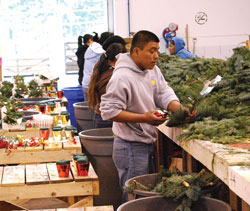 A team of workers assembling various Christmas greens products at the Hiawatha Corp. facilities in Shelton, WA.In January, we begin negotiating early proposals, ideas for new products are on the drawing board, vendors are being contacted for new pricing on raw materials and hard goods, a thorough inventory begins and projections for the upcoming season are being established.
Continuing into February and March — while others are thinking about Valentine’s Day and St. Patrick’s Day —we are ordering component samples, securing prices for lumber to build bins, negotiating prices on materials and hard goods and creating customer price lists.
By April — as the grocers are pushing to sell through their Easter lilies — we are writing purchase orders for supplies, finalizing new products and photographing them for marketing.
Above all holidays, Mother’s Day represents substantial sales for the floral industry. In May, while we are aiming to obtain projections from our customers, florists are focused on selling flowers for mom. During this month our sales department diverts attention to prepare for the upcoming International Floriculture Expo.
In June, once we return from the IFE show, the process begins with follow-up calls, mailing catalogs and price lists, sourcing special components and preparing quotes for custom programs. While sales continue to do their part, the production crew spends the rest of the summer setting up the buildings and grounds so all is ready for the big production push.
Although Independence Day is more about picnics than flowers, many buyers take their vacations in July, making it difficult for the sales department to make contact. Therefore, July through August is spent trying to contact buyers to confirm their holiday commitments.
August also brings two more shows in which we exhibit before Christmas production begins.
September is when orders start coming in and the number of piece workers hired for production is based on orders that have been confirmed and submitted. Because the majority of the piece workers are migrant laborers, there is always a delay in hiring all that are needed until they are finished working the fall harvest. Our company has around 45 year-round employees and during production we hire 800-900 piece workers.
Production begins at the end of September and continues until a week before Christmas. Truckloads of fresh greens are delivered daily, as decorator items are being made, cased and placed into cold storage until shipment.
Our busiest time of the entire year happens in a very short window of time, peaking the week before, during and after Thanksgiving Day.
Although Christmas greens are our largest category, it is important to note that during the hustle and bustle preparing for Christmas production, we are also harvesting and shipping Western greens and Moss products all year long.
Kim Toizer is assistant sales manager at the Hiawatha Corp. in Shelton, WA. She can be contacted at [email protected].