California drought affecting flower growers thorughout the state
California drought affecting flower growers thorughout the state
The effect of the California drought on flower growers differs widely in the various growing regions of the Golden State. Much of Northern California is in a state of water emergency and Southern California is essentially a desert area that needs its water transported in from miles away. Flower farms in those two areas of the state have been more adversely affected than those along the Central Coast.
The present dry spell has been increasingly compared to the historical 1976-77 drought that led to exceptional water shortages and caused temporary cessation of agricultural activities in some parts of the Central Valley.
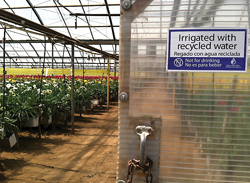 The Gerbera house at Kityama Bros. uses a combination of well and recycled water for irrigation.According to the National Oceanic & Atmospheric Administration, the present drought is the result of one modestly dry year (2012) and one record dry year (2013, 20 percent drier than any year in history since NOAA began keeping records). And 2014 isn’t starting out much better.
There doesn’t seem to be much hope for significant rainfall in California in the near future due to a weather pattern entrenched over the Pacific Ocean that is causing the dry conditions in the West and extremely cold temperatures in the Midwest.
Kasey Cronquist, chief executive officer of the California Cut Flower Commission, said California’s flower farms, in general, were well prepared for the dry period by using techniques such as drip irrigation and hydroponics using recycled water.
“We’ve been through these types of situations before and most of our farms have already implemented the kinds of conservation strategies that are necessary,” Cronquist said in an interview with a regional radio station in February.
In the northern flower-growing region, Stuart Kitayama, operations manager at Kitayama Bros. in Watsonville, told The Produce News many growers in the area are very concerned about the drought.
“We are located along Monterey Bay and our wells are within a mile of the ocean. This area has over-pumped the aquifer for decades and the water table is at or below sea level,” Kitayama said. “The current dry spell has been going on for several years and 2013 was extraordinarily dry. This reduces the natural recharge of the aquifer and exacerbates the problem.”
Kitayama added that the farmers on the coast and those losing well capacity are the most affected. He said that if next winter is also dry, farmers will reduce their acreage planted and there will be a strong push for conservation and restrictions.
In the event of mandatory water rationing, Kitayama said, “We have reservoirs for storing water, we are connected to the coastal distribution system that’s connected to the recycle plant — about half our irrigation water is recycled water — and we collect and irrigate with rainwater. This year we will recycle our hydroponic irrigation water and monitor and reduce our irrigation use.”
Along the Central Coast in Santa Barbara County, growers in the Carpinteria Valley have not been seriously affected by this year’s lack of rain. Ed Van Wingerden, owner of Ever-Bloom Nursery in Carpinteria, told The Produce News that Ever-Bloom obtains its water from wells on its properties that draw water from the aquifer. The only expense is the cost of pumping the water out of the ground, he added.
Ever-Bloom is required by state and local regulations to manage its water runoff with a recycling program. Van Wingerden said that because the company grows everything hydroponically, it is simply good economics to recycle its water. It recaptures the nutrients from the fertilizers in the recycled water, thereby reducing Ever-Bloom’s expenses.
The Carpinteria Valley Water District, which supplies the water needs of the community, also draws its water supply in part from the aquifer. Bob McDonald, district engineer, told The Produce News the district monitors aquifer levels closely and it is not presently concerned about the supply.
“In the natural ten-year cycle, the level of the aquifer tends to balance out. It rises and falls, depending on the amount of rain we receive,” McDonald said. “We are presently in the second year of the down cycle and we will continue to closely monitor the levels.”
In the state’s southern flower-growing region, Troy Conner, president of Kendall Farms in Fallbrook, knows the toll that farming takes on natural resources. The company recently installed a 2 million gallon reservoir and water treatment system used to capture and recycle almost all of the water used on the farm.
“We have installed the most efficient drip irrigation system available to make sure no water is wasted,” Conner said in a recent article posted online. “We have our own wells throughout the farm and when combined with our water recycling programs we no longer have to use any imported water for our flower and greens production.”
In San Diego County, flower growers rely on water transported from hundreds of miles away. Frank Biddle, owner of FBI Flowers in Vista, told The Produce News that he buys his water from one of the irrigation districts in his area.
“We have the choice of two different rate plans, either a commercial rate or a residential one,” said Biddle. “The commercial rate is much less expensive, but when there is a water shortage, our water can be diverted to the residential users and we can be left high and dry — literally.”
Some farmers in the area are choosing to pay the higher residential rate just to ensure they will have the necessary water if the drought situation worsens, he said. Because this year has been very warm in addition to being dry, Biddle has needed to irrigate more than previous years and his water expense has increased fourfold.
The higher cost of water in the entire southern region has pushed growers to invest in new technologies in order to become more sustainable.