California cherry market remains hot as season winds down
California cherry market remains hot as season winds down
Lack of volume has created a demand-exceeds-supply situation for California cherries, which is expected to remain the case until shippers from the Golden State finish up their crop around June 10 and Washington shippers enter the deal.
On May 22, the Market News Services reported the best varieties and largest cherries were selling for as much as $90 for a 16-pound carton, while the smallest cherries and less popular varieties were still well above $50 per carton. An average price appeared to be in the $70-80 range depending upon the size of the cherries, the variety and the pack.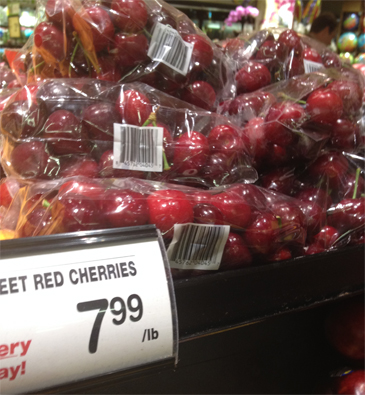 A demand-exceeds-supply situation resulted in cherry prices that ranged from $7 to $10 per pound over the Memorial Day weekend.
Earlier in the season, the market spiked to as high as $120 for a carton of large cherries. These high prices were reflected at retail as a survey of several Northern California supermarkets revealed prices ranging from $7 to $10 per pound over the Memorial Day weekend.
Mike Jameson, director of marketing for Morada Produce Co. LP in Linden, CA, told The Produce News that the lack of chilling hours during the dormant winter months has produced one of the smallest cherry crops in California history.
He explained that a cherry tree needs many hours of below 45 degree F temperature during the winter to set a crop. In addition, he said the daytime temperatures can't rise too high or that has a negative impact on the chill hours.
In mid-March, nighttime temperatures did drop to 40-45 degrees but the daytime temperatures rose to 80-85 degrees.
"It was like a furnace in the orchards," he quipped.
That affected bloom drop and negatively affected pollination, resulting in a much smaller crop.
Matt Nowak, domestic sales account manager for Delta Packing Co. Inc. in Lodi, CA, concurred with Jameson's assessment, saying, "We just had too warm of a winter. The trees never went to sleep."
In 2013, California produced almost 8 million cartons of fresh-market cherries. "This year, we will be lucky to get to 3 million," he said. "I think we will be short of that."
Nowak said San Joaquin Valley shippers typically have cherries past the middle of June and into the latter half of the month. "This year we will be finished by June 10," he said.
Jameson said Morada could be out of California cherries even a few days earlier than that. "Normally we last until June 15-20, but not this year."
As the two men were talking in the latter half of May, the Bing cherry crop was just starting to be harvested, and it is down significantly. Bings are the most popular California variety.
"A good crop of Bings could be 4 [million] to 5 million cartons," said Jameson. "This year, the estimate was 1.8 million cartons, but I think we will end up at 1.2-1.3 million."
Relief is on the way however from the Northwest.
Howard Nager, vice president of marketing for Domex Superfresh Growers in Yakima, WA, said May 27, "We began picking today in a very light way. We are going to have about 500 boxes. We will get going in earnest next Monday or Tuesday (June 2-3)."
The Domex executive said the pipeline should be fairly empty when Washington starts shipping in good volume around June 10-15. At that point, though, the price should start to fall to more reasonable levels.
Nager predicted promotable supplies and pricing by the third week of June. "There should be plenty of product around for Fourth of July promotions," he added.
He said Washington had a very good growing season this year and the crop has been estimated at about 21 million 20-pound carton equivalents. That would be about a 50 percent increase over the 2013 crop from Washington, which was hit with rainy weather and only rose a bit over the 14 million-carton mark.
Washington should have sweet cherries at least through mid-August.