Bushmans’ introducing Mexico-Wisconsin growing program at Viva Fresh
Bushmans’ introducing Mexico-Wisconsin growing program at Viva Fresh
Nogales, AZ — Visualizing a symbiotic relationship between Mexican vegetable and Wisconsin vegetable production and packing, Bushmans’, Inc., is launching a creative new business arrangement.
Coordinating the effort for the Rosholt, WI-based firm is T.J. Bauer, who works from an office here near the Mexican border. Bauer, who has worked in this industry since 1990, became Bushmans’ general manager in October 2015.
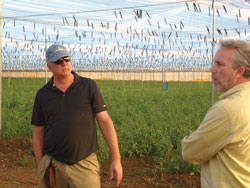 Wisconsin grower Dick Okray, a partner with Bushmans’, Inc., based in Rosholt, WI, with Michael Gatz, Bushman’s director of business development, on a Mexican greenhouse visit in late January. Bauer is coordinating an effort that will move both workers and farm equipment between Mexican and Wisconsin fields to capitalize on opposite seasons to have a 12-month vegetable deal. The concept will be formally introduced by Bauer and his Wisconsin colleagues at the Viva Fresh Expo in San Antonio, March 31-April 2.
There will be nine growing locations in Mexico. Those vegetables will cross through Nogales, Eagle Pass, TX, or Otay Mesa, CA, which is across the border from Tijuana. The first Mexican harvest in this plan would commence in April in Magdalena, Sonora, which is not far south of Nogales.
In Wisconsin, Bushmans’ has long been established as a major fresh potato grower-packer-shipper. But for the summer 2016 growing season, Bushmans’ is working in Wisconsin with independent growers to produce green beans, pickles, pole cucumbers, beans, zucchini, yellow and hard squash. There are plans to produce bell peppers and eggplant in 2017. The typical Wisconsin vegetable harvest season runs from July through September.
“There will not be massive acreage at first” in this effort, Bauer said.
Mexican workers will be carefully trained to work within Bushmans’ quality parameters and then will be bused under the H2A legal foreign worker program to Wisconsin for the summer deal. These workers will be well-versed in food-safety training. Employing the same workers throughout the year greatly reduces training costs, Bauer noted. The job position is attractive to Mexican workers in significant part because of long-term employment.
Expensive vegetable production equipment will also be shipped across the border to accommodate opposite growing seasons. A critical machine is a bean harvester which replaces 100 workers. “We will machine harvest and hand pack,” Bauer added.
As with its Wisconsin potatoes, Bushmans’ will be capitalizing on the “locally grown” appeal of its new vegetable deal.
As to a processed market option, Wisconsin is the home of one of the country’s largest bean processors, Bauer indicated.
The plan will integrate “the best of both worlds,” which include an abundance of land, water and economical logistics. Wisconsin vegetable production “does not face the water and freight issues of California.” Trucking costs to Wisconsin from California can be $8,000 per load, Bauer added.
The shipping label and same quality specifications will apply. “We will have a very consistent look between Mexico and Wisconsin,” Bauer noted.