Bejo Seeds focused on model that benefits growers, retailers and consumers alike
Bejo Seeds focused on model that benefits growers, retailers and consumers alike
Bejo Seeds Inc. is on a mission to revolutionize the industry. Rather than just breed for durability and yield, Bejo is maneuvering to create products that provide a win-win scenario for growers, shippers, retailers and — the key and often strangely overlooked link in the chain — consumers.
The company is experiencing breakout success with its Tasti-Lee tomato, licensed from the University of Florida Institute of Food & Agricultural Sciences and now entering the mainstream. The highly flavorful, long-keeping tomato is proving to be a hit with consumers and retailers alike, despite a higher price point that is targeted to stay level regardless of market conditions.
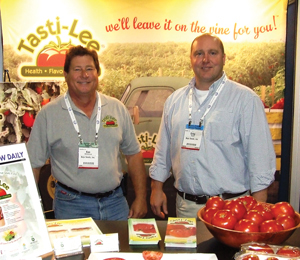 Ken McCammon and Greg Styers of Bejo Seeds Inc. at the company’s booth at last year’s PMA Fresh Summit. The Tasti-Lee was one of the show’s big hits. (Photo by Chip Carter)The simple key to the Tasti-Lee’s success? It tastes good, with a much higher flavor profile than standard commercially grown tomatoes or tomatoes-on-the-vine.
Most companies “are giving lip service to this, talking more about breeding for flavor, but probably the advantage Bejo has is we do have a really strong breeding department and we’re very well financed. We can be that little company that can afford all the technology, go back to our research and development facility in Holland — you’d be amazed,” said Director of Marketing Jeff Trickett. “We can do all the stuff the big guys can do, but being a smaller, family-owned enterprise, we’re faster on our feet and more willing to take a chance on something that others might view as being too small.”
Take cabbage, for example. Often the vegetable is an afterthought, a filler to carry other flavors.
“There’s some opportunity with cabbage to bring that from sauerkraut and coleslaw into the mainstream. We have some products that taste very good, with thin, delicate mild leaves, not the traditional product most people think of,” Mr. Trickett said. “There are going to be a lot of examples where we would go attack something that other people might not want to get involved in, some segments of the business the big boys probably shy away from. They want to attack the big crops and the big categories. Probably the most important thing we’re doing is, while continuing to breed for the grower interest, I think we’re doing a good job of breeding for consumer attributes and we seem to have a lot of products that lend themselves well in that regard — flavor, taste profile, aroma, appearance, color, health and nutrition.”
Carrots are another area where Bejo is trying to raise the bar. Most consumers are beginning to realize most prepackaged “baby” carrots are simply regular carrots trimmed to bite-sized shapes. Bejo is developing baby carrot varieties that actually deliver the full flavor profile of a true baby carrot, as well as colored carrots that have more than simple surface appeal.
“If you look at the category today, basically you have the huge cut-and-peel business, which is positioned as a baby carrot — it’s just a long skinny carrot that gets cut and processed. I don’t see a lot of effort in carrots with respect to flavor and eating enjoyment,” Mr. Trickett said. “The cut-and-peel segment has lost some ground because its focus has been on getting the shape and size and the effort toward flavor has not really been a top priority.”
Bejo is also working on a variety of other specialty products, and is further developing its reputation as a developer of top-quality onions and shallots, a category where “most of the retail stuff now is just the leftovers, the bad stuff that doesn’t go to the restaurant industry, so there’s opportunity there,” Mr. Trickett said.
Bejo places equal emphasis on ensuring returns to growers.
“A lot of these segments truly are commoditized. Tomatoes are not selling for much money right now, but ‘Tasti-Lee’ is a level-price program: We set our price and stick to that, so growers are benefiting from that,” Mr. Trickett said. “We have a model where not just anybody can grow or sell ‘Tasti-Lee.’ You’re limiting who can benefit. We do have a limited number of licensed growers, but each grower has a large assortment of contracted business growers at a fixed price well above market price, and these guys get a good return and a guaranteed return and they know going in what they’re going to get for it and they get paid. We have a system now where growers have some leverage back against the retailer.”
Surprisingly, even retailers do not seem to have a problem with that approach.
“I was a little worried initially that we’d get some pushback from retailers but the reality is they’ve all embraced it and I’ve even gotten comments like, ‘What a relief, I don’t have to worry about where the market’s going, I can budget, I can forecast,’ so, amazingly, even the retailers are quite content,” Mr. Trickett said. “Any time you do something different you’re going to get some friction, but I feel comfortable with the progress we’re making. We’ve had a few growing pains, but I think our model is viable and will be successful. But it does take a little bit of time to get people used to new ideas.”