After successful second season, Goldew expansion is around the corner
After successful second season, Goldew expansion is around the corner
With its second season winding down, Peppadew Gold peppers, produced by Peppadew Fresh LLC in Morganville, NJ, are poised to see an increase in production in the Garden State, with a future goal of expanding to other growing districts.
Pierre Crawley, managing director of the company, said the affiliation with the "Jersey Fresh" program and the Shop Rite supermarket chain, owned by Wakefern Food Corp. in Elizabeth, NJ, has been a great boost to the product this year.
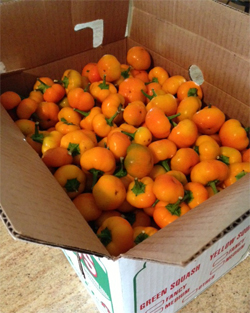 Peppadew Gold, or Goldew, received a boost from its affiliation with the 'Jersey Fresh' program this year. Next year, he would like to see more growers in New Jersey produce the unique fruit. And further down the road, he expects to see growers in other districts across the country grow the sweet pepper.
The Peppadew Gold, or Goldew, traces its roots to South Africa where the Peppadew was first discovered in the 1990s. Its founder discovered a bush with bright red fruit that seemed to be a cross between small red peppers and cherry tomatoes. The fruit was dubbed Peppadew to reflect its peppery flavor and the sweetness of dew. Botanically, it is a member of the capsicum family
The fruit was first marketed in South Africa and then brought to the United States about a dozen years ago, marketed in jars with a brine solution.
The Goldew is from the same family and was also discovered in the wild in South Africa before becoming a commercial venture. It was also initially sold in brine jars, but Crawley's firm brought some seeds to New Jersey to see how it would do.
"It grows very nicely in this area," he said. "The Northeast is very conducive to producing Goldew."
Unlike the Peppadew red, which takes almost six months to produce a crop from seed, Crawley said Goldew goes from seed to production in about 90 days. That makes it a much more economical option for New Jersey growers.
Once the crop proved viable, Peppadew Fresh purchased an old flower farm and began planting the seeds in an open field. This year, the company produced about five acres of Goldew. Because of the connection with "Jersey Fresh," Peppadew Fresh was able to tap into the robust locally grown program that Shop Rite touts in the Garden State.
With its mid-August to mid-October harvesting window, Crawley assessed this season as it was winding down on the last day of September. "Shop Rite marketed Goldew in their pepper set in basically all 300 of their stores," he said. "It did very well."
Priced at retail in the $2 to $3 per-pound range, Crawley said it appeals to shoppers "wanting something a little different or unique." The "Jersey Fresh" aspect was also emphasized, which played very well with the shoppers in the area who love buying locally grown product. At store level, signage told consumers to "core and roast it," giving them one serving suggestion. It can also be eaten raw as is the case with other peppers.
And Melissa's/World Variety Produce, the California specialty produce firm that also distributes Goldew from Peppadew Fresh, advises consumers to stuff it with cheese and eat the small round fruit as a one-bite appetizer. Crawley says it has many culinary uses.
With the supports of a USDA grant for the growing and marketing of the product, Peppadew Fresh expects to entice other New Jersey growers to grow the fruit for next year. And beyond that, Crawley said it would be natural for production to expand to other regions to service local markets.
"It makes sense that to market it in California, we should have production out there," he said. "Our goal is to have Goldew become a mainstream item."
He believes the uniqueness of the product, with its perfect round shape and distinct flavor, will give it universal appeal.
While red Peppadew continues to be a strong product for the company, Crawley does not expect it to follow the lead of Goldew and become a fresh- market product. He said the length of the growing season makes it a difficult crop for the Northeast and its shorter growing season.
In addition, most growers, even in warmer climates, wouldn't want to give up virtually two crop seasons for one crop. So that item will continue to be grown in South Africa and exported to the United States in jars.