Port of San Diego invites produce trade
Port of San Diego invites produce trade
san diego — The Unified Port of San Diego is already a significant player in North America’s international produce trade. Since 2002, refrigerated container ships belonging to Dole Food Co. have made weekly calls on San Diego.
But port leaders are encouraging North American fresh produce traders to consider an alliance as the port makes an aggressive move to expand its business.
Representing the port in a recent meeting with The Produce News were Stefan Baumann, the port’s principal of maritime business development, and Miguel Reyes, the manager of maritime trade development. Edward Plant, who owns Harborside Refrigerated Services Inc. also participated in the interview. The port of San Diego is the landlord to Harborside, which operates 250,000 square feet of refrigerated cold storage space on the dock and 50,000 square feet of dry storage.
When it comes to building San Diego’s role, “we mean business,” said Baumann. “There are new growth opportunities here. We want to focus on perishables,” said Baumann.
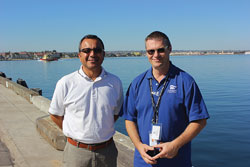 On a San Diego dock are Miguel Reyes and Stefan Bauman of the Unified Port of San Diego.Plant observedhat the port is geographically well-aligned to serve three specific produce shipping areas: Nogales, AZ, California’s San Joaquin Valley and Baja California shippers and their San Diego distributors. These three deals have mostly-separate production seasons.
“Dole has 15,000 tons of cargo a week that comes through here,” Plant noted.
The frozen strawberry business coming from Baja, Mexico, involves 100 million pounds. “We could easily hold 50 percent of that,” Plant said. The limiting factor is public policy rules that regularly impact his business.
Plant said plans are underway to bring electric gantry cranes to the port. This presence will attract liner business in addition to Dole. The port is also dealing with balancing industrial uses with surrounding residential and tourist serving uses.
The port of San Diego offers much to growers, distributors and ocean carriers, Baumann added. There is BNSF rail service leading straight to the port’s cold storage facility. The Mexican border, which leads directly to Baja, is 20 minutes down the freeway.
Prospective clients may find that San Diego is a place to serve relatively small-volume sea trade as an alternative to the massive volumes and congestion at the port of Los Angeles. “We are not an L.A. so everybody” considering doing business in San Diego “is a big fish. Miguel and I can tell customers how much free time they’ll have at the dock. And we have flexibility.” Uncongested waters are another benefit for ships calling on the Port of San Diego.
“In the near future we could possibly handle 1,000- to 2,000-TEU ships that have been squeezed out of Los Angeles. We could be a ‘little LA’ like they were many years ago,” said Baumann.
Dole’s ships are 770 FEUs. This is a forty-foot equivalent unit versus the twenty-foot equivalent of the TEU measure.
The 42-foot water depth on San Diego’s main dock gives plenty of water for specialized ships bearing fresh produce.
Reyes said “the low hanging fruit” for exporting from San Diego is southbound for Mexico, Central America and South America. San Diego is one day closer by sea to Latin America than its competitors in Los Angeles.
Shipping lines carrying perishables to China or Japan are also a possibility, Baumann said. Dry goods manufactured in Asia provide abundant backhaul possibilities.
The port is planning to tear down two old dry warehouses in the near future to make room for holding more reefer containers. This will, of course, include requisite electrical plugs.
The port is designated the Unified port of San Diego because it is a state agency involving five towns on the waterfront in this area. Two of these cities, San Diego and National City, both have dock facilities. But it is the San Diego facility with the refrigeration services.
Baumann joined the Unified port of San Diego in September. He was previously associated with the por tof Tucson in Arizona.