Hadley’s Albert Keck finds consumers responsive to health message
Hadley’s Albert Keck finds consumers responsive to health message
Dates have a good story to tell with regard to health benefits, and Albert Keck, president of Hadley Date Gardens Inc. in Thermal, CA, believes that consumers are responsive to the health message.
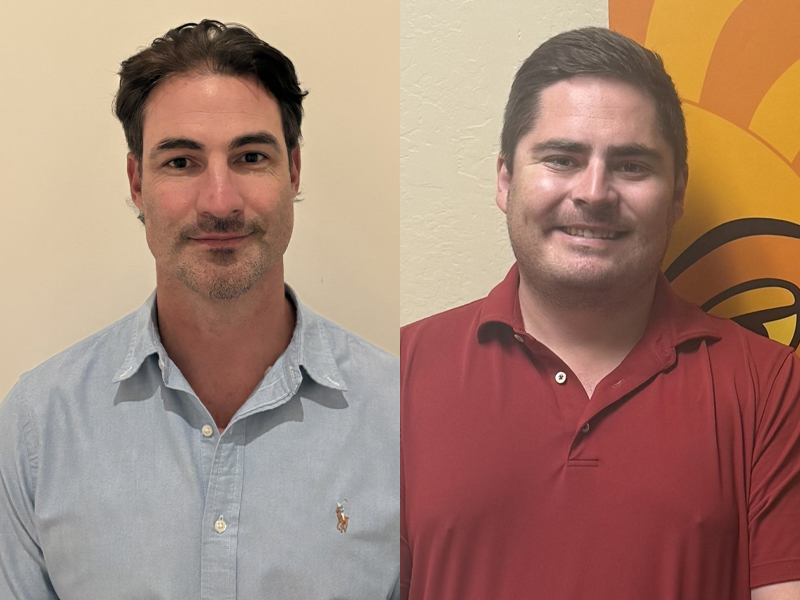
 Sean Dougherty and Albert Keck of Hadley Date Gardens in a young date grove.He acknowledged that he does not base that conclusion on the analysis of vast quantities of retail sales data such as some large companies and associations purchase at considerable cost from firms that collect such data. But “I do think that the culture is becoming more in tune with the health benefits” of particular foods, and notably of dates, “and people are much more intentional in pursuing them.”
That is true not only with consumers but with culinary professionals, which is leading to more and more use of dates in foodservice menus, he said.
“We are also seeing a lot of growth in the health bar, trail mix, energy foods type of business. It is encouraging.”
Overall, “it just seems like there is an increasing cultural acceptance of dates,” he continued. Date prices “never fluctuate too much, but the demand seems brisk.”
Dates have been certified to use the American Heart Association’s Heart Check Mark, and at Hadley, one of the methods the company is using in its health messaging campaign is to put the AHA Heart Check logo on its packaging, Mr. Keck said.
In addition, “on our label we now have the California Grown logo.”
Everyone in the date industry in California is grateful for the increased interest in dates due, at least in part, to a growing awareness of their health benefits, Mr. Keck said. “Fifteen years ago, we were all crying that the date consumers were going away,” and now dates are enjoying an upswing in popularity.
“I think there is more [growth] to be had,” he said. “There is a great story to tell with the product.”
About three years ago, Hadley introduced a new consumer pack style for its dates — a square tub. Those have become very popular, Mr. Keck noted. “They show the product off nicely” and have “a very crisp and clean presentation.”
Hadley is using a side label on the square tubs in addition to the top label, he said. “I think it is a more appealing format than the flatter clamshell. It is certainly a higher-quality package than the typical clamshell” such as used for blueberries, for example. “I think it is something that the produce managers can really work with and make a lot of business with.”
Hadley is not currently doing a whole lot of consumer direct promotional stuff like we did in the old days,” but “we are working with a few retailers” on promotional activities, Mr. Keck said. For example, “we will support a coupon campaign here and there.”
The company offers Medjool, Deglet Noor and Zahidi varieties. In addition, “we’ve got a smidgen of other varieties, but those are just a boutique pursuits of mine” with very small production, Mr. Keck said.
The product line includes whole fresh dates and pitted dates as well as “Date Nuggets” (a Hadley trademark) and date coconut rolls.
Retail pack styles include vertical square tubs in sizes from 10-ounces to 16-ounces, flat round plastic tubs and cups. The company also offers larger plastic tubs in two-pound, three-pound and 3.5-pound sizes for club stores and bulk sales for industrial customers, as well as co-packers and repackers.
The Medjool harvest was expected to start in late August, Mr. Keck said Aug. 22. “Deglets will start early October.”
Volume will be up this year as “a lot of our younger orchards are now starting to take hold,” he said. “We are starting to see the increasing volumes that we have been waiting for” from trees planted five to seven years ago. “It is a patience game. [Full] production on those young trees doesn’t really come until about 12 years or more.”
The market “has been supporting the growth,” he said. “It wants the volume.” Demand “has been brisk.”
All of Hadley’s dates are “grown here locally on our orchards and our contract orchards. All are California grown,” he added.