CF Fresh plays vital role in developing year-round organic apple, pear programs
CF Fresh plays vital role in developing year-round organic apple, pear programs
CF Fresh has weathered the ups and downs of the organic market from its earliest days, and today occupies a leadership role for its dedication, vision and persistence.
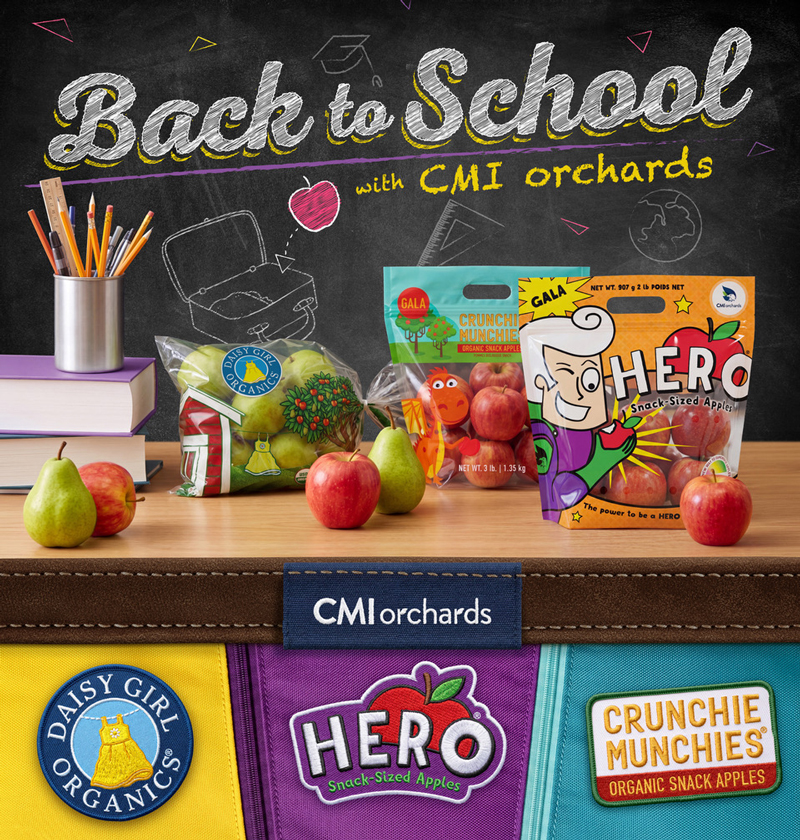
 CF Fresh worked with producers in different regions to develop one of the first organic apple and pear programs with year-round availability. (Photo courtesy of CF Fresh)“Organic has come a long way, from a small niche market with tiny volumes and a spotty record on quality and consistency to a full-fledged category represented in mainstream retail markets across the country,” said Addie Pobst, the company’s import coordinator and food-safety officer. “We’re especially proud of the part CF Fresh played in working with producers in different regions to develop the first organic apple and pear program with year-round availability.”
The company’s history is strong and consistent. “In 1997, we were the first company to import certified organic apples from Chile and Argentina,” Mr. Pobst told The Produce News on Aug. 20. “Our imported organic produce complements our domestic supply and enhances the viability of the broader organic market. Having organic apples available year-round enables organic product to compete for permanent space in mainstream retail produce departments.”
According to Ms. Pobst, the relationship between domestically-produced and imported product is one of complementary existence and mutual benefit. “I am often asked, sometimes rather bluntly, if our import program threatens the market share of our domestic apple growers,” she said. “But I think a better way to look at it is that our import program helps hold the door open for our domestic producers in their off-season. Having year-round availability of fresh organic apples means retailers are willing to commit produce department space to the category. And that, in turn, helps grow the organic market for everyone — including local growers. Retailers need consistency in their supply chain, and apples are a primary element in any produce department. Just imagine a retail produce department without organic apples for several months. Keeping organic apples available in the market all year raises the visibility of the organic category as a whole, and that has really helped organic produce expand market share into mainstream retail channels over the years.”
CF Fresh is headquartered in Sedro-Woolley, WA, and has worked to develop long-term relationships with its growers over the years. “Many of the growers whose produce we market today have been with us for years, including the growers who produced those first organic imports back in 1997,” she said. “Together, we’ve seen good crop years and bad crop years. But we’ve cultivated strong relationships thanks to a shared commitment to sustainable agriculture and a mutual love of great produce.”
Ms. Pobst was asked to evaluate the current organic market and provide her observations about the ways in which it has changed over the past year. “The demand this season has been much stronger than last season,” she replied. “Beginning in the South American import season and continuing through the California harvest, we’ve seen a resurgence in enthusiasm from retailers and consumers alike for organic produce.”
She said consumers continue to be interested in purchasing locally grown produce. But the concept of what exactly is local is morphing. “A lot of consumers are interested in the idea of supporting locally grown produce. Our commitment to sustainable agriculture means that, among other things, we streamline our logistics to avoid moving any products even one foot farther than it needs to go,” she noted. “There are some common misconceptions and confusion about what exactly constitutes ‘locally grown’ produce, and in many cases simply measuring the miles between the farm and the store — food miles — is not a good way to evaluate the energy footprint or sustainability of a product.”
But she went on to say anything that encourages consumers to think about the importance of agriculture and sustainability in their lives, environment and the economy is a net positive. “Farmers markets and local food economies, small family farms, organic and sustainable agriculture go hand in hand,” she said. “As I pointed out above, some people imagine a conflict between locally or regionally grown produce. But the reality is that a stronger and more inclusive organic market benefits producers of all stripes and sizes.”
Ms. Pobst was asked if she had any demographic data to show who the strongest consumers of organic products are. She based her response on a report issued by the Organic Trade Association in 2011. “Families with children seem to be the most prominent group, with 78 percent of U.S. families reporting that they bought organic food in 2009, according to the OTA’s 2011 report. The number one motivator cited by parents for choosing organic foods is ‘healthier for me and my children.’ And that’s for the third consecutive year, again according to the OTA’s 2011 report.”