Schools are America’s largest nutrition platform, and we’re not fully using it
Schools are America’s largest nutrition platform, and we’re not fully using it
If we step back and look at the landscape of public health in the United States, one thing becomes clear: schools represent one of the most powerful — and underleveraged — nutrition platforms we have.
Every single day, millions of children interact with federally supported feeding programs. Whether through the National School Lunch Program, School Breakfast Program or educational snack-based initiatives like the Fresh Fruit and Vegetable Program, schools are not just places of education, they are daily touchpoints for food exposure at scale.
For those of us in the produce industry, that should matter. If our goal is to meaningfully increase fruit and vegetable consumption across the population, there is no more scalable environment than K–12 schools. The infrastructure is already built. The funding mechanisms exist. The audience is captive, consistent and formative.
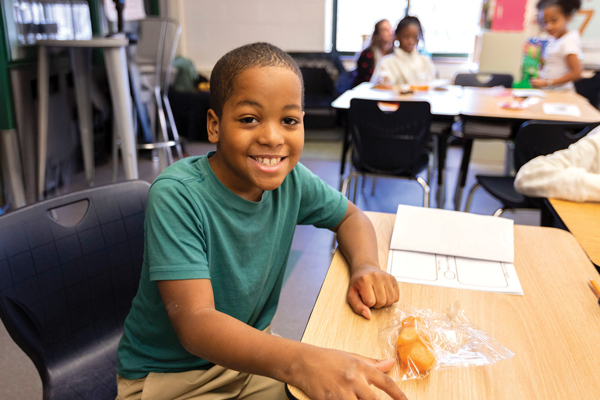
guarantee that they will eat it, enjoy it or seek it out again in the future.
The opportunity is not theoretical, it’s sitting in front of us every school day, but we also need to be honest with ourselves about something.
For decades, nutrition policy has focused on improving access to healthy food. Programs like FFVP have played a critical role in expanding the availability of fresh produce, particularly in lower-income schools. That progress should be recognized and protected.
However, access alone is not enough to drive lasting behavior change.
Simply handing a child a piece of fruit or a serving of vegetables does not guarantee that they will eat it, enjoy it or seek it out again in the future. Anyone who has spent time in a school cafeteria or classroom knows this intuitively. We’ve all seen unopened items end up in the trash, or a hesitant bite followed by a quick rejection.
The reality is that preference is not built in a single moment, it is developed over time.
Children often need repeated exposure to unfamiliar foods. They need context, confidence and most importantly, they need a positive experience that helps shift perception from “this is different” to “this is normal.”
Without that, we are distributing product, but we are not building habits.
This is where food education becomes essential.
When fruits and vegetables are paired with intentional education like taste testing, classroom discussion, visual learning tools and repeated exposure, the dynamic changes. The snack is no longer passive. It becomes interactive, and it becomes more memorable.
Organizations like Pilot Light have demonstrated what this can look like in practice, through standards-based approaches that integrate food into everyday learning. Their Food Education Standards provide a framework for helping students understand where food comes from, how it connects to their health and culture and how to engage with it over time.
When paired with programs like the FFVP, this approach turns exposure into a learning opportunity.
We’ve seen this firsthand through our work at DNO Produce by integrating produce into classrooms alongside structured educational components like our SnackTime Explorers Program. When a student understands where a food comes from, how it grows, what it tastes like, and how others experience it, their willingness to engage increases dramatically.
It’s not about forcing consumption. It’s about building familiarity.
Over time, familiarity turns into comfort. Comfort turns into preference, and preference is what ultimately drives behavior both inside and outside the school environment.
This is especially important when we consider the broader food landscape children are navigating. Ultra-processed foods are engineered to be consistent, convenient and immediately gratifying. Fruits and vegetables operate differently. They are more varied, and require exposure, repetition and trust.
If we want produce to compete, we have to meet that reality head-on.
The good news is that we don’t need to build something entirely new to address this. Programs like FFVP already provide the foundation. They are funded, structured and embedded within the school day.
The opportunity in front of us is to enhance these programs. To evolve them from simple distribution models into integrated exposure and education platforms.
That means aligning product delivery with classroom engagement. It means equipping educators with tools that make it easy to incorporate food into learning. It means thinking about produce not just as an item, but as part of a broader experience.
This is not something that the produce industry, schools, nonprofits or policymakers can solve independently. Together, there is a clear path to scale something that is both practical and impactful.
This issue is not just professional for me, it’s personal.
As a father of seven, I see every day how exposure, repetition and environment shape how kids think about food. Preferences are not fixed. They are formed, and they are formed early.
Schools give us a window into that formation process at a national scale.
If we get this right, the impact extends far beyond the classroom. We are not just influencing what a child eats during a snack period, we are helping shape how they make food choices for the rest of their life.
That’s a responsibility, but more importantly, it’s an opportunity, and it’s one we can’t afford to miss.