Organics key for Four Seasons’ long-term growth strategy
Organics key for Four Seasons’ long-term growth strategy
Organics have evolved from a niche offering into a core business driver for Four Seasons Produce, a shift that reflects both long-term vision and changing consumer demand.
The company’s commitment to organics dates back to its founder, David Hollinger, whose early interest in health foods helped shape the organization’s direction well before the category gained widespread traction.
“In the 1990s, we made a decision to dedicate resources to organics on both the procurement and sales side,” Jon Steffy, general manager of the Ephrata, Pennsylvania-based Four Seasons Produce, told The Produce News. “At the time, it was a very small and unprofitable part of the business, but David believed in its long-term potential.”
That early investment has since paid off. In the early 2000s, organics represented about 5 percent of sales but have grown to account for more than half of the company’s business over the past decade. Today, top organic categories for Four Seasons include berries, salads, bananas, avocados and wet vegetables, all of which continue to see steady demand across retail channels.
While the company offers a full organic produce assortment, recent growth has come from expanding into adjacent fresh categories with strong attribute-driven appeal.
“We’re seeing increased demand from natural channel retailers for items like meat, dairy and deli that are organic, pasture-raised, grass-fed or regenerative,” Steffy said. “We’re also excited to support Regenerative Organic Certified growers and help connect those products to the marketplace.”
The broader organic category has matured significantly over the past two decades, moving from a specialty segment to a more mainstream offering.
“The quality of organic produce has improved dramatically, and availability has expanded through increased acreage and imports,” Steffy said. “At the same time, pricing has become more competitive with conventional, which has helped drive consumer adoption.”
Looking ahead, the company expects continued, albeit more moderate, growth.
“The growth curve isn’t as steep as it once was, but we still see incremental gains and strong loyalty from organic shoppers,” the company noted.
 Effective merchandising
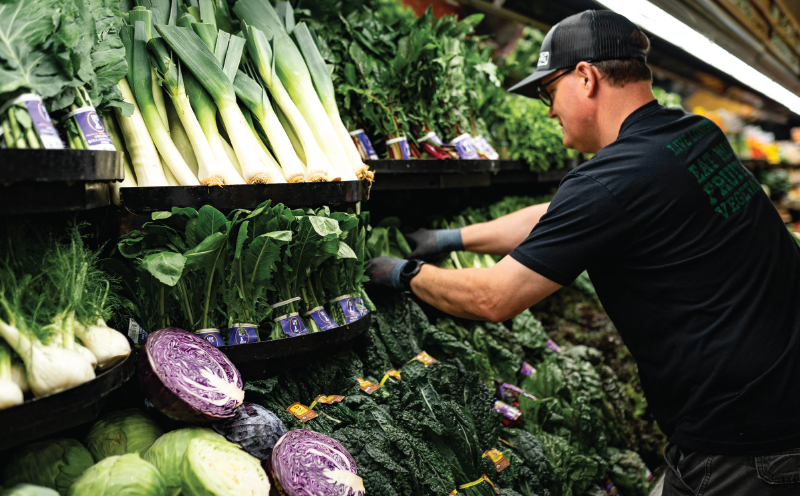
Four Seasons believes that effective merchandising remains a key strategy for driving sales at retail.
“We see the best results when organic produce is actively promoted through ads, in-store specials and seasonal displays,” Steffy said. “Quality and availability are critical, but promotion really helps unlock the category’s potential.”
The company works closely with its retail partners, particularly independent operators, to support organic programs through merchandising, planning and in-store execution. Steffy said the company assists retail clients with produce department resets, display builds, staff training and troubleshooting, as well as with ad writing and promotional strategy.
Steffy said an organic shopper differs from a conventional shopper who differs from a crossover shopper in terms of what they are looking for.
He advises retailers to interact with their customers to gauge their preferences, and to experiment and measure results. This is more easily accomplished by smaller independents that are more nimble.
“Independent retailers have a real advantage in their flexibility,” Steffy said. “Those who adapt their organic assortment seasonally and take advantage of promotional opportunities can generate strong momentum.”
At the same time, the Four Seasons executive cautioned against a static approach.
“When retailers treat organics as a fixed set and don’t evolve their offering, results can plateau,” he said. “Retailers that adjust seasonally with organic assortment and promote spot buys or feature unique items can get sales momentum that can surprise them.”
As consumer interest in organics continues to broaden beyond traditional demographics, Four Seasons remains focused on supporting both growers and retailers in expanding access to the category.
“We’re grateful for the farmers and retailers who are committed to bringing high-quality organics to more shoppers,” Steffy added.