How women are shaping Sun World’s next era of flavor — and what 50 years of innovation really looks like
How women are shaping Sun World’s next era of flavor — and what 50 years of innovation really looks like
There’s a “tell” at Sun World’s table grape tasting events.
When the bowls run dry — when scientists, breeders and agronomists have eaten every last sample before the session ends — Jennifer Petersen knows they’ve found something. No spreadsheet required. No consumer panel. Just an empty bowl and a room full of people who can’t stop reaching for more.
“You can always tell the favorite varieties,” said Petersen, Sun World’s executive vice president and chief science officer since 2021, “by the ones where there is quickly nothing left.”
It’s a small moment, but it says everything about how Sun World has operated for 50 years — and why the company, celebrating its golden anniversary in 2026, remains one of the most influential forces in fresh produce genetics. At Sun World, the science is serious and the data is sophisticated, but the north star has never changed: make fruit so good that people can’t help themselves.
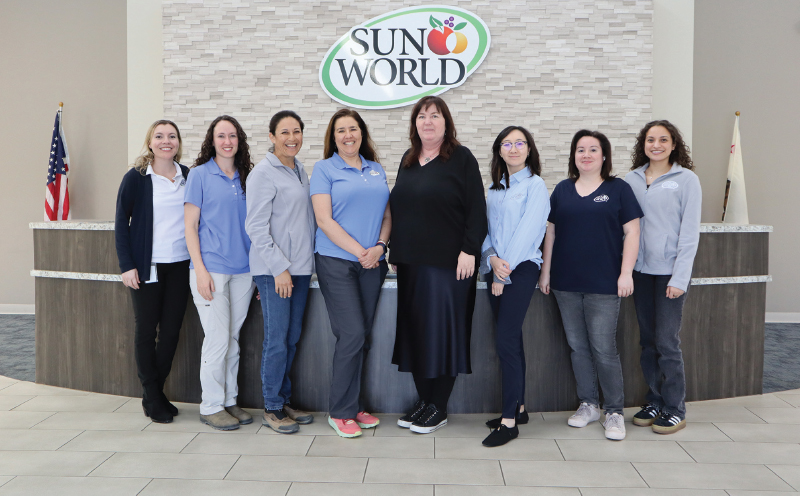
That mission is deceptively simple and yet extraordinarily complex to execute. It runs through every lab, every field trial and every breeding decision the company makes, including the work of women like Petersen, table grape breeder Paola Barba, breeding technology lead Esther Niu, and agronomists Chris Hanssens and Kayla Gerberich, whose combined expertise spans genetics, molecular science and grower partnerships across four continents.
Flavor Is Designed, Not Discovered
Ask Barba what she does for a living, and she’ll tell you she designs grapes that don’t exist yet.
As the manager of Sun World’s table grape breeding program, Barba spends her springs making deliberate crosses between carefully selected parent plants, her summers evaluating thousands of resulting selections and her falls deep in data — analyzing flavor, color, texture, yield and resilience before deciding which few candidates are worthy of moving forward.
“No two days are ever the same,” she said. “That constant evolution is what makes this work so energizing.”
What surprises people, Barba noted, is how intentional the process is. Exceptional grapes don’t simply appear. They are architected — trait by trait, season by season — through a painstaking combination of scientific rigor and sensory judgment. Her goal isn’t incremental improvement. It’s transformation.
“I’m excited to surprise both the produce industry and consumers with the table grapes we’ll be introducing in the years ahead,” she said.
Barba joined Sun World in late 2022, bringing fresh perspective to a program with deep roots. That blend — institutional knowledge meeting new energy — is a pattern you see across the company’s innovation teams, and it may be one of the quiet secrets behind Sun World’s longevity.
What a Seedling Already Knows
Fifty years ago, Sun World’s breeders selected varieties largely the same way they still do today — by tasting them. Experience, instinct and a well-trained palate were the instruments.
Today, those instruments have been joined by something Niu’s team calls molecular markers — and the results are quite extraordinary.
As Sun World’s breeding technology lead, Niu oversees the fruit quality, tissue culture and molecular labs at the company’s research headquarters in Wasco, CA. Her team’s work has made the breeding process faster, more precise and increasingly predictive. Using molecular analysis, they can now identify whether a grape will be seedless while it is still a tiny seedling — years before it ever produces fruit.
But that’s not even the most striking part.
“We’ve launched sensory and consumer research, training panels to evaluate appearance, texture and flavor,” she explained. “We’ve discovered that taste preferences vary widely by region. With enough data, we can even use AI to predict what consumers will love and guide variety releases around the world.”
Think about what that means for a company with global grower partners; the ability to anticipate what a shopper in Seoul or São Paulo or Stockholm will reach for, before the variety has ever been commercially grown. Science meeting story. Flavor meeting feeling. That’s Sun World at 50.
“It’s exciting to work at the intersection of science and innovation,” Niu said, “building on the giants before us while shaping the future of plant breeding.”
She has been with Sun World for nine years — long enough to have watched the molecular tools she now deploys daily go from emerging possibilities to standard practice. The pace of change, she noted, is only accelerating.
From the Lab to the Earth
A grape variety can be genetically brilliant, molecularly validated and sensory-panel approved — and still fail, because ultimately a variety has to grow. In real soil, in real climates, under real pressures. That’s where Sun World’s Global Technical Services (GTS) team comes in.
Hanssens leads agronomic teams across Mexico, Peru, Brazil, and Chile — four countries with four distinct sets of conditions, challenges and grower relationships. Her job is to bridge what the breeders and scientists have developed with what is actually possible and profitable for growers in the field.
“By prioritizing the specific technical needs of each region and variety,” she said, “we are able to effectively guide and align the work carried out each season, ensuring consistency, performance and long-term value.”
Hanssens has been with Sun World for nearly six years, and what she has built across Latin America is not just a technical operation — it’s a feedback loop. Insights from her regional teams flow back to breeding priorities. What a grower in Chile observes about a new variety’s canopy behavior in high heat ultimately shapes decisions made in a lab in California. The pipeline doesn’t just run one direction.
Gerberich knows that loop intimately. As an applied varietal research agronomist focused on citrus, mangoes and avocados, she works alongside GTS colleagues to design field trials and evaluate how new varieties perform across wildly different growing environments. She joined Sun World less than a year ago and already has a philosophy that could serve as a model for the entire industry.
“Always take the opportunity to talk and interact with your growers,” she said. “They may have the next cutting-edge idea that could lead to the next innovation within the industry.”
In a world of increasingly sophisticated science, it’s a beautifully grounded reminder — the field is still the ultimate laboratory.
The Team That Keeps the Bowl Full
Back in Wasco, Petersen reflects on to what five decades of fruit genetics actually amounts.
Sun World’s journey from its grower-shipper-packer roots to a global genetics and licensing business — home to brands like AUTUMNCRISP grapes and an expanding portfolio of mango varieties — represents one of agriculture’s quieter, more consequential transformations. Genetics changed what fruit could be, and the people who drove those changes, Petersen is quick to note, never worked alone.
“When people visit our research headquarters, they frequently compliment me on the team and how energetic, smart and capable they are,” she said. “They see a diverse group of people that come together every day to use the power of science to improve people’s lives.”
That sense of collective purpose — and the joy that comes with it — may be the most durable thing Sun World has built across 50 years. The varieties will keep evolving. The tools will keep advancing, but the instinct to gather around a table, taste something new and reach for another handful? That’s not a product of technology.
That’s human connection. That’s on what the next 50 years are built.
And somewhere at a Sun World event right now, there’s probably an empty bowl that proves it.