National Mango Board celebrates 20 years of impressive growth
National Mango Board celebrates 20 years of impressive growth
 In 2005, the year the National Mango Board was launched, the per capita consumption in the United States of what is often called the world’s most popular fruit was at a pedestrian 1.9 pounds per person. As NMB was recently celebrating its 20th anniversary, it proudly pointed out that the consumption level has almost doubled to 3.5 pounds per person.
“There is still lots of opportunity for future growth,” NMB Executive Director Ramon Ojeda recently told The Produce News.
He reasoned that a tracking survey sent to 1,000 homes on regular basis for the last dozen years reveals that only about one in four households has a mango on hand at any time. “The opportunity is there for a lot of growth,” he reported.
In fact, he said that the biggest challenge facing the mango industry moving forward is to match mango supply with demand. Ojeda added that it is not a winning growth strategy to create demand when, for one reason or another, you don’t have the supply to fill that demand.
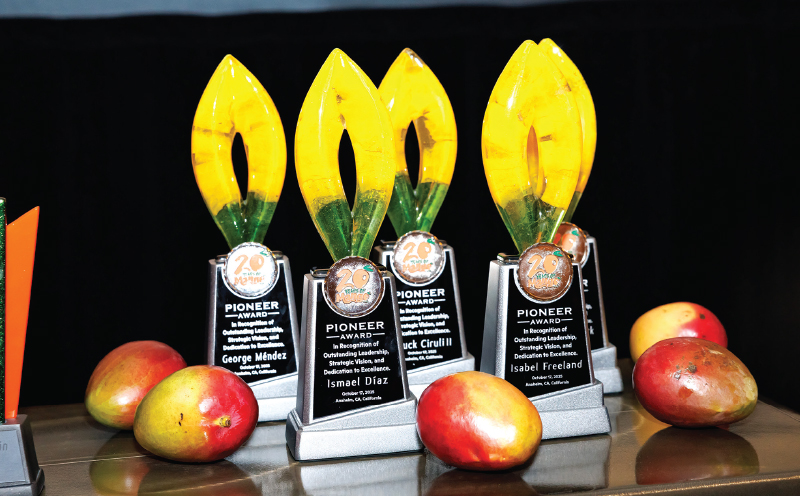
The board’s third executive leader during those 20 years said NMB is addressing those challenges on many different fronts, which he articulated. First, Ojeda wanted to step back and honor the work that has been done over the last two decades that has led to the phenomenal growth. The National Mango board did just that during the annual gathering it holds in conjunction with the International Fresh Produce Association’s October trade show, which was held in Anaheim, CA, this year.
“We honored the two executive directors that preceded me (William Waton and Manuel Michel) as well the 90 board members that have served our industry during that time,” he said.
The event highlighted two decades of growth, research and impact in advancing America’s love for mangos.
Ojeda noted that 20 years ago, the mango barely registered on the list of America’s most popular fruit. During the first half of 2025, mangos cracked the top 10 of most consumed fruit in the United States. According to NMB, in 2024 the ROI on mango promotions over the years reached a very high level. It claims that for every dollar the industry has invested in the promotion board’s programs during the past decade, the industry has gained $16 in return.
In terms of dollar growth, U.S. mango imports have increased 255 percent since 2005, accounting for $929 million in sales in 2024. Weather issues in the major mango producing regions have taken their toll on volume the last couple of years, but total cartons sold has still surpassed 130 million boxes annually. It was as high as 144 million boxes in 2022, and Ojeda said that number will soon be surpassed if Mother Nature cooperates.
In fact, the National Mango Board’s stated goal is to have a mango in every grocery basket by 2030.
Ojeda said the effort to achieve that goal plays out on two complimentary fronts throughout the year. In the first place, the board is constantly working to increase mango consumption through both promotion and education. One of the main selling points for the fruit is its excellent nutritional profile. More than 40 nutrition and health studies have documented the nutritional value of the fruit and that message is constantly presented to consumers through social media and promotional material.
In addition, NMB has been involved in more than 100 production/post-harvest studies with the information being shared up and down the supply chain to improve the quality and flavor of the fruit delivered to consumers. Ojeda said much varietal work has been done as well as research on handling mangos and getting them from their point of origin to the consumer in the best shape possible. He added that it is excellent flavor that creates repeat sales.
Mexico supplies the United States with about 60 percent of its mango supplies, with Peru, Ecuador, Brazil, Guatemala and Dominican Republic also being significant points of origin. The United States does have a domestic industry as well but that only accounts for about 1 percent of U.S. sales.
Because many of those foreign suppliers are quite far from U.S. ports of entry, Ojeda said the supply chain issues are challenging. He noted that a box of mangos from Mexico can be on a U.S. retailer’s shelf within two days of picking, but the journey from Peru can be close to a month on the ocean. In most instances, mangos must go through a hot water treatment before entering U.S. commerce. Ojeda said irradiation is becoming more popular with an expected 10 million boxes utilizing that treatment option this year, a four-fold increase since 2021.
Despite the logistic challenges, Ojeda noted that the growers, exporters, importers, distributors and retailers provide consumers with an excellent piece of fruit, witnessed by the tremendous growth since the turn of this century.
In the United States, ethnic consumers, including Latinos and African Americans, continue to over-index on consumption and drive increased consumption, but gains are being made across many demographics. Largely because of the demographic makeup of the United States, East and West Coast consumption is on the high end of the spectrum. Ever-optimistic Ojeda said that fact reveals lots of opportunities in the Midwest.
Looking beyond the horizon, Ojeda is convinced that the future is very bright — even brighter than the past two decades. As he mentioned, flavor is the top selling point of the mango experience, and he expects even more flavorful fruit in the coming years. “We are in the middle of the research on identifying genetic markers for mangos,” he said. “Five to 10 years down the road, we will have better varieties with better resistance to pest and climate change issue.”
He added that these new mangos will have better flavor and perform better for the consumer. “It’s only a matter of time,” Ojeda promised, reiterating the goal of having a mango in every U.S. grocery basket by 2020.