America’s grocery carts get a health check
America’s grocery carts get a health check
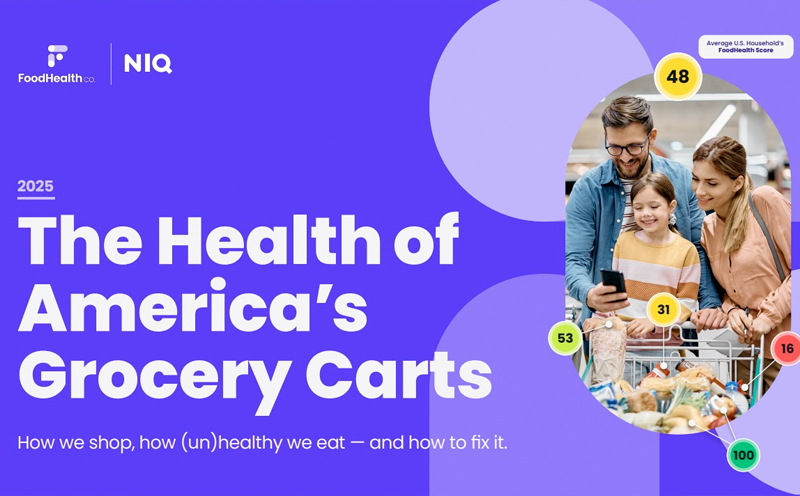
A first-of-its-kind analysis covering more than 200 billion grocery purchases and 70,000 U.S. households shows that the typical American grocery basket scores just 48.94 out of 100 on the FoodHealth Score, a new nutrition index developed by the FoodHealth Co.— 55 percent below an ideal score of 88, which indicates a basket aligned with positive long-term health outcomes.
These and other findings, developed in partnership with NielsenIQ, are unveiled in the inaugural Health of America’s Grocery Carts report, painting the clearest picture yet of American nutrition and how our food choices vary by demographics and life stage.
“Everyone knows what a credit score is — it predicts your financial health. The FoodHealth Score works the same way, but for your body. It shows how the food you buy today is likely to shape your health in the long run,” said Sam Citro Alexander, founder and CEO of FoodHealth Co. “Our mission is to make the health of our food choices measurable, transparent, and easy to improve.”
“This collaboration brings the power of our data to one of the most important questions of our time: what are we really eating?” said Beth Morris, vice president of product insights at NielsenIQ. “By pairing NielsenIQ’s unparalleled view of consumer purchases with FoodHealth Co.’s scoring system, we can finally quantify how everyday choices add up — and help the industry move toward a healthier food ecosystem.”
This analysis was powered by the same FoodHealth Score technology available to the food industry. The FoodHealth Co. and NielsenIQ have partnered to turn the underlying data behind this report into an actual market offering—now available directly through the NielsenIQ platform.
What the Report Covers
- What Americans are buying — broken down by state, food category and demographics, including comparisons between SNAP participants and non-participants.
- How healthy those purchases are — using one clear, consistent metric that allows households, retailers and policymakers to measure progress over time.
- An overlay of food health and chronic disease — exploring whether people are healthier in regions where grocery baskets score higher.
- Cost and correlation — whether healthier foods really cost more, across categories and geographies and how knowledge, education and availability drive purchasing decisions.
Key Metrics in the Report
- American Household FoodHealth Score (1–100): Composite measure of household grocery purchases based on nutrient density and ingredient quality.
- Quadrant Classification: Color-coded guidance for recommended consumption frequency, modeled on the Mediterranean diet, the world’s most clinically validated framework for chronic disease prevention.
- Nutrition & Pricing Data: Analysis revealing how food cost, availability, and quality intersect across the nation.
Key Findings
- The average U.S. shopping cart scores 55 percent below the level associated with long-term health.
- A 10-point increase in FoodHealth Score points is associated with measurable improvements in key health biomarkers
- There is no correlation between how much a household spends on groceries and how healthy those purchases are.
- Households receiving food assistance (ie: SNAP) shop about as healthfully as those that don’t.
- The healthiness of household food purchases drops sharply once children reach school age.
Next Step: A Grocery Game-Changer
Coinciding with the report, FoodHealth Co. will debut a new Chrome Extension that allows any American to instantly see the FoodHealth Score of their online grocery cart — a simple, free tool designed to turn insight into everyday action.
“Everyone deserves transparency when it comes to what’s in their food,” said Alexander. “With the FoodHealth Score, we’re giving consumers, retailers and policymakers the same data-driven visibility that has long existed in finance — because food is the most powerful daily health decision we make.”
“Food is the most powerful daily health decision we make,” said Morris at NielsenIQ. “By quantifying what’s in our carts, we’re giving consumers and retailers a new lens on public health.”