Florida strawberry study aims to help boost profits
Florida strawberry study aims to help boost profits
Florida's strawberry industry continues to evaluate strategies to produce outstanding fruit of the highest quality while at the same time providing growers with the best return on investment.
According to a University of Florida study, Florida and California combined produce 99 percent of domestic strawberries.
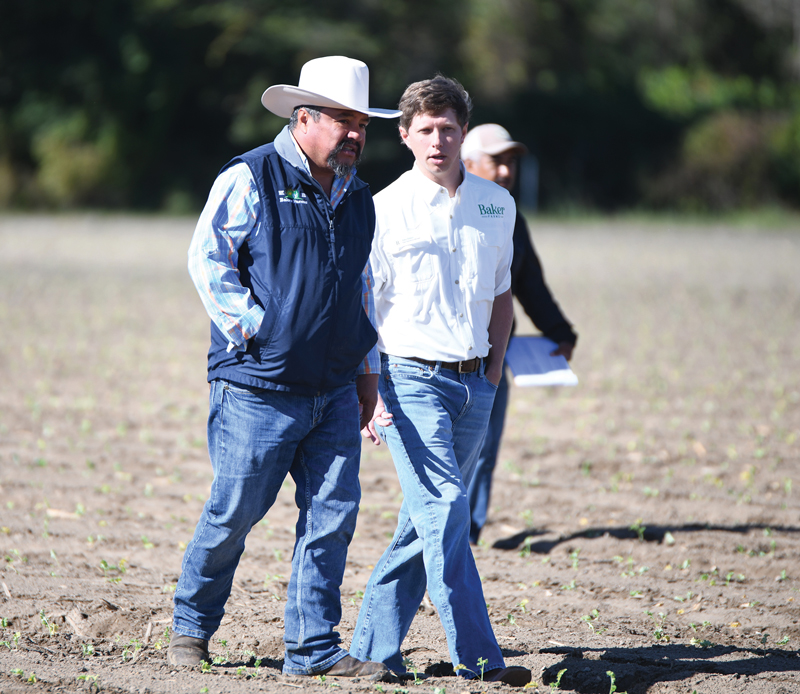
“Florida ranks as the largest producer of winter strawberries, with a value of $366 million annually, according to the U.S. Department of Agriculture,” the report states. Vance Whitaker, a strawberry breeder with the University of Florida's Institute of Food and Agricultural Sciences, is co-author of a study that encourages Florida's strawberry growers to plant and harvest earlier to maximize profits. According to the U.S. Department of Agriculture, strawberries are a $366 million annual crop in Florida. Photo courtesy of the University of Florida.
“Optimizing yield distribution under biological and economic constraints: Florida strawberries as a model for perishable commodities,” was authored by Feng Wu, Zhengfei Guan and Vance Whitaker, in association with the University of Florida's Gulf Coast Research and Education Center and Food and Resource Economics Department and was released Oct. 23.
The interdisciplinary study proposes “a modeling framework for deriving the optimal yield curve for strawberry production in Florida that maximizes the profit of growers given competition from California and Mexico and sensitive price responses to market supply.”
The results of the study can be used to guide efforts and make decisions in breeding and improvement of cultural practices and would assist growers in making informed decisions on cultivars and technologies/practices to adopt to maximize profit.
With Mexico emerging as a major competitor to the Florida strawberry industry, Whitaker recommended that Florida strawberry growers look to an earlier pick date in mid-November to remain competitive and maximize profits.
Kenneth Parker, executive director of the Florida Strawberry Growers Association, provided The Produce News with his insights about the study and the ways in which Florida strawberry growers are working to cultivate the best possible varieties while maximizing return on investment.
“Dr. Whitaker is a great friend,” Parker said. “The study shows what the growers know. We have a lot of confidence in our breeding program at UF.”
Hillsborough County, known as the Winter Strawberry Capital of the World, produces 15 percent of the nation's strawberries and virtually all of the berries grown during the winter months.
Parker said cost inputs continue to increase, and prices are typically higher at the beginning of the Florida season, which generally runs from Thanksgiving to Easter. “We always want to get better,” he stated. “Varieties grown in Florida are much better than they were five years ago.”
Much of the challenge Florida's strawberry growers face stems from the Sunshine State's multifaceted climate characterized by heat, rain, humidity and even seasonal cold spells. Plants currently in production in Florida don't fare well until Florida heat begins to moderate. Pest pressures are nothing new in Florida's warm, humid subtropical climate. “We need to increase early production and have predictable volume throughout the season,” he continued. “Having complementary varieties is what we're shooting for.”
Cold weather becomes a factor as production ramps up around the end of November, meaning growers must employ a variety of techniques such as use of rainbirds, row covers and newer coatings to protect the plants and their fruit.
“The growers have been good stewards of the land,” Parker continued, adding that Florida is not exempt from having to deal with its own water issues. “They are using less water today than a decade ago.” Use of drip irrigation in strawberry fields has had a positive impact. “The growers are using one-half less water today than they did a decade ago,” Parker added.
Florida has staked its reputation on the production of premium fruit with an outstanding flavor profile and longer shelf life. “We have a really good handle on this,” he said.
Parker said Sue Harrell, the association's director of marketing, has been working tirelessly to enhance brand recognition in the retail sector for the Florida strawberry industry. “Sue has done a great job promoting strawberries,” he said.
Harrell, who is also a strawberry grower, said the industry continues to seek out the perfect variety that will help growers check off all their production boxes. “We don't have the perfect one yet,” she told The Produce News.
A number of varieties, including the Sensation, have been patented and commercialized through the Gulf Coast Research and Education Center since 1992.
Strawberry cultivation is truly a hands-on industry. Harrell said plant runners must be trimmed, enabling the plants to produce more berries. “It's done by hand. So it's expensive,” she commented. But the intense works does pay off. “Our buyers at the retail level know our fruit is good through these varieties,” Harrell added.
The industry participates in the “Fresh From Florida” branding program which enhances product visibility on the produce shelf. “The campaign is really effective,” Parker said. “Mexico is our competition.” He said Harrell has developed a strong tagline for Florida strawberries that says it all: “You can have a taste of summer all winter long.”