South Africa citrus season underway
South Africa citrus season underway
GLOUCESTER CITY, NJ -- The South African citrus import season is officially underway, as evidenced by the bright red refrigerated bulk cargo ship Indian Reefer disgorging pallets of South African citrus on June 8, here, at the Gloucester City Marine Terminal.
Indian Reefer was docked nose to nose facing a white cargo ship unloading Chilean apples and some other Chilean fruit. South African citrus grower Gerard Stone, whose company, Bokwater, located in Clanwilliam, South Africa, is the first of eight South African growers to take up temporary residence in this area near Philadelphia this summer in order to keep an eye on fruit arrivals. The Produce News met with Mr. Stone June 8 to discuss the South African citrus business.
Mr. Stone said that 180 South African citrus growers formed a shipping alliance after a very bad marketing season in 2000. The group uses a promotion name Summer Citrus, that is casual and not a brand name. The growers independently market but they do communicate about marketing plans so as to not disrupt one another's markets as happened in 2000.
Mr. Stone ships his fruit through a South African export company, Everseason (Party) Ltd. in Citrusdal. He said that he can ask Everseason to ship to certain importers, but he also listens to Everseason's advice. This June, Mr. Stone was packing the "Ocean Spray" label for DNE World Fruit Sales in Ft. Pierce, FL. But he made it clear that he was not in New Jersey to promote his fruit, nor speaking with The Produce News to put his fruit ahead of his neighbors.
The Summer Season alliance has pooled its resources to reduce shipping costs for five years. Mr. Stone showed a DVD created by Summer Season to show the sophistication of the South African citrus export industry, which enjoys "hot, dry summers and crisp, friendly winters." It is a citrus-disease-free area, with growers adhering closely to U.S. Department of Agriculture phytosanitary standards. There are three USDA inspection stations for citrus in the area, and 36,000 tons of citrus will be shipped this year. Varieties include Navels, easy peelers, lemons and Valencias. The fruit is exported from Cape Town Harbor.
Of South Africa's citrus growers for the 2000 season, Mr. Stone said, "We didn't have a clue about marketing to the USA."
Despite shipping a perishable product within a certain marketing window, within three or four weeks to launch in the 2000 season, there was a huge excess of citrus for sale in the United States. "There was no planning or organization. We wanted to do it right, so we looked at what the Australians were doing" in organizing as an industry and marketing their citrus exports to the United States. "We learned a lot and started a controlled, professional marketing effort [for the 2001 season]."
These growers collectively have the volume to load a refrigerated break bulk reefer ship every seven to 10 days. There are about 1,200 pallets per ship. If Summer citrus shippers don't fill a ship, independent shippers are sold space. "We look after our members first," he said.
Mr. Stone said that his industry doesn't refer to "boxes" or "cartons" because the clementines and other soft citrus are shipped in five- pound (2.3-kg) boxes, while other citrus goes in 15-kg. boxes. Thus, referring to numbers of boxes is irrelavent.
He said that there was some early South African citrus harvested that could wait for the first reefer ship this year. As a result, six or seven containers were shipped to the United States for arrival before June 8.
There will be about 30,000 pallets of South African citrus shipped to the United States this year.
Mr. Stone packs a "very limited" number of "Ocean Spray" brand boxes. This is because fruit first intended for the U.S. market may be rejected by USDA and might suddenly need to go to Europe or the Far East. There, a receiver competing with DNE might be receiving his fruit, thereby creating an awkward situation. This year he plans to mostly pack under the "Everseason" brand. "I will just do 'Ocean Spray' for specific customers," he said.
Because a couple of false codling moths were found on South African citrus last year, the South African industry has agreed with the USDA to extend its cold treatment program to 23 days this year, up from the 21 days in prior years. The ships' refrigeration is now held at minus-1 degree Celsius for 23 days. Ships can sail from South Africa to the Delaware River in 18 days, but they slow down to accommodate the cold temperature requirements.
South African shippers this season launched a grove program to release sterilized, or "mule," male false codling moths. Due to be completed by next year, the mules breed but produce no young, which is effective in quickly controlling that moth population. "We're doing this to improve the program to the United States," Mr. Stone noted.
"It's been a good growing year," said Mr. Stone. The individual fruit is smaller in size than usual, but "the total crop is an average size. We had good rains starting the season for the first time in three or four years. The quality is good, like normal. South Africa produces the best-tasting citrus anywhere in the world."
Mr. Stone jokingly insisted that no growers ever have a profitable year, but he did confess that "last year the U.S. was one of the best markets because of the exchange rate."
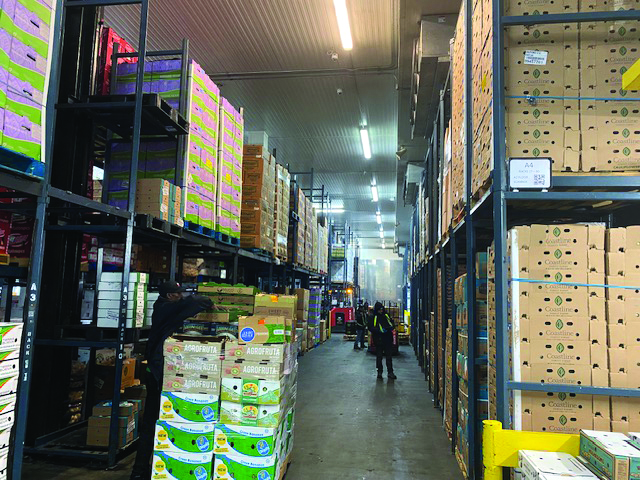
The European market "last year and this year are disastrous with too much volume" because South Africa faces many other international competitors in serving Europe with citrus. As the cargo ship Indian Reefer unloaded, the pallets in the warehouse of the Gloucester Marine Terminal bore many different labels.
Marc Solomon, president of Fisher Capespan U.S.A. LLC, is marketing the "Outspan" brand and other labels of South African citrus this summer. Fisher Capespan keeps a permanent office in a comfortable building with a dramatic river view near the Gloucester Marine Terminal.
Mr. Solomon, a native of South Africa, said that independent brands "highlight the grower." He noted that it is human nature to pay more attention to quality if the grower's name is on the box vs. packing another brand name.
Mr. Solomon added that the shipping label is often inconsequential as much of the imported citrus is repacked into bags. Thus, neither the trade nor consumers ever see the original shipping carton. "We repack into the 'Outspan' brand to control quality."
In a June 9 interview, Mr. Solomon said that about 30 percent of the fruit coming off the Indian Reefer was for his company. Fisher Capespan will receive as much as 40 percent of the fruit coming off later reefers from South Africa.
Noting that a discussion of South Africa's citrus learning curve is "old news," he said that the trade now is doing well in shipping times and volumes. Quality standards are significantly improved and "there is a flow to balance supply and demand."
He credited the Australian industry for setting high quality standards, "and we had to match those." He said that a North American retailer who recently visited South Africa proclaimed to a grower group that South African citrus has now surpassed the quality of Australia.
Most of the South African citrus arriving early this shipping season is clementines, "which definitely are seeing an increasing demand in North America."
Mr. Solomon continued that California clementine production has generally increased demand for the fruit in the West, which has been helpful in shipping South African clementines to the West Coast.
Spanish clementine shippers, who have been in the market much longer than South African shippers, were effective in building clementine demand on the U.S. East Coast, he said.
The market is relatively empty early in the summer for the clementine and Navel deals, Mr. Solomon said. California Navel shipping "has basically ended." As is becoming routine, the South Africans are competing with Chileans with summertime clementines in North America.
Mr. Solomon said there is increasing demand for two- and three- pound clementine bags in the summer months. This gives retailers more options in price points.
Mr. Solomon said the Northern Cape area of South Africa is increasing its Navel shipments. The Hartswater area, 600 miles east and north of the traditional Western Cape citrus growing district, is a desert region, with chilly nights and hot days, which equate to Arizona citrus growing areas. Hartswater growers are now in their third season of shipping to North America. These Navels are "extremely good" and have an increasing volume. "I think we will have a great season," Mr. Solomon said.
Indian Reefer was docked nose to nose facing a white cargo ship unloading Chilean apples and some other Chilean fruit. South African citrus grower Gerard Stone, whose company, Bokwater, located in Clanwilliam, South Africa, is the first of eight South African growers to take up temporary residence in this area near Philadelphia this summer in order to keep an eye on fruit arrivals. The Produce News met with Mr. Stone June 8 to discuss the South African citrus business.
Mr. Stone said that 180 South African citrus growers formed a shipping alliance after a very bad marketing season in 2000. The group uses a promotion name Summer Citrus, that is casual and not a brand name. The growers independently market but they do communicate about marketing plans so as to not disrupt one another's markets as happened in 2000.
Mr. Stone ships his fruit through a South African export company, Everseason (Party) Ltd. in Citrusdal. He said that he can ask Everseason to ship to certain importers, but he also listens to Everseason's advice. This June, Mr. Stone was packing the "Ocean Spray" label for DNE World Fruit Sales in Ft. Pierce, FL. But he made it clear that he was not in New Jersey to promote his fruit, nor speaking with The Produce News to put his fruit ahead of his neighbors.
The Summer Season alliance has pooled its resources to reduce shipping costs for five years. Mr. Stone showed a DVD created by Summer Season to show the sophistication of the South African citrus export industry, which enjoys "hot, dry summers and crisp, friendly winters." It is a citrus-disease-free area, with growers adhering closely to U.S. Department of Agriculture phytosanitary standards. There are three USDA inspection stations for citrus in the area, and 36,000 tons of citrus will be shipped this year. Varieties include Navels, easy peelers, lemons and Valencias. The fruit is exported from Cape Town Harbor.
Of South Africa's citrus growers for the 2000 season, Mr. Stone said, "We didn't have a clue about marketing to the USA."
Despite shipping a perishable product within a certain marketing window, within three or four weeks to launch in the 2000 season, there was a huge excess of citrus for sale in the United States. "There was no planning or organization. We wanted to do it right, so we looked at what the Australians were doing" in organizing as an industry and marketing their citrus exports to the United States. "We learned a lot and started a controlled, professional marketing effort [for the 2001 season]."
These growers collectively have the volume to load a refrigerated break bulk reefer ship every seven to 10 days. There are about 1,200 pallets per ship. If Summer citrus shippers don't fill a ship, independent shippers are sold space. "We look after our members first," he said.
Mr. Stone said that his industry doesn't refer to "boxes" or "cartons" because the clementines and other soft citrus are shipped in five- pound (2.3-kg) boxes, while other citrus goes in 15-kg. boxes. Thus, referring to numbers of boxes is irrelavent.
He said that there was some early South African citrus harvested that could wait for the first reefer ship this year. As a result, six or seven containers were shipped to the United States for arrival before June 8.
There will be about 30,000 pallets of South African citrus shipped to the United States this year.
Mr. Stone packs a "very limited" number of "Ocean Spray" brand boxes. This is because fruit first intended for the U.S. market may be rejected by USDA and might suddenly need to go to Europe or the Far East. There, a receiver competing with DNE might be receiving his fruit, thereby creating an awkward situation. This year he plans to mostly pack under the "Everseason" brand. "I will just do 'Ocean Spray' for specific customers," he said.
Because a couple of false codling moths were found on South African citrus last year, the South African industry has agreed with the USDA to extend its cold treatment program to 23 days this year, up from the 21 days in prior years. The ships' refrigeration is now held at minus-1 degree Celsius for 23 days. Ships can sail from South Africa to the Delaware River in 18 days, but they slow down to accommodate the cold temperature requirements.
South African shippers this season launched a grove program to release sterilized, or "mule," male false codling moths. Due to be completed by next year, the mules breed but produce no young, which is effective in quickly controlling that moth population. "We're doing this to improve the program to the United States," Mr. Stone noted.
"It's been a good growing year," said Mr. Stone. The individual fruit is smaller in size than usual, but "the total crop is an average size. We had good rains starting the season for the first time in three or four years. The quality is good, like normal. South Africa produces the best-tasting citrus anywhere in the world."
Mr. Stone jokingly insisted that no growers ever have a profitable year, but he did confess that "last year the U.S. was one of the best markets because of the exchange rate."
The European market "last year and this year are disastrous with too much volume" because South Africa faces many other international competitors in serving Europe with citrus. As the cargo ship Indian Reefer unloaded, the pallets in the warehouse of the Gloucester Marine Terminal bore many different labels.
Marc Solomon, president of Fisher Capespan U.S.A. LLC, is marketing the "Outspan" brand and other labels of South African citrus this summer. Fisher Capespan keeps a permanent office in a comfortable building with a dramatic river view near the Gloucester Marine Terminal.
Mr. Solomon, a native of South Africa, said that independent brands "highlight the grower." He noted that it is human nature to pay more attention to quality if the grower's name is on the box vs. packing another brand name.
Mr. Solomon added that the shipping label is often inconsequential as much of the imported citrus is repacked into bags. Thus, neither the trade nor consumers ever see the original shipping carton. "We repack into the 'Outspan' brand to control quality."
In a June 9 interview, Mr. Solomon said that about 30 percent of the fruit coming off the Indian Reefer was for his company. Fisher Capespan will receive as much as 40 percent of the fruit coming off later reefers from South Africa.
Noting that a discussion of South Africa's citrus learning curve is "old news," he said that the trade now is doing well in shipping times and volumes. Quality standards are significantly improved and "there is a flow to balance supply and demand."
He credited the Australian industry for setting high quality standards, "and we had to match those." He said that a North American retailer who recently visited South Africa proclaimed to a grower group that South African citrus has now surpassed the quality of Australia.
Most of the South African citrus arriving early this shipping season is clementines, "which definitely are seeing an increasing demand in North America."
Mr. Solomon continued that California clementine production has generally increased demand for the fruit in the West, which has been helpful in shipping South African clementines to the West Coast.
Spanish clementine shippers, who have been in the market much longer than South African shippers, were effective in building clementine demand on the U.S. East Coast, he said.
The market is relatively empty early in the summer for the clementine and Navel deals, Mr. Solomon said. California Navel shipping "has basically ended." As is becoming routine, the South Africans are competing with Chileans with summertime clementines in North America.
Mr. Solomon said there is increasing demand for two- and three- pound clementine bags in the summer months. This gives retailers more options in price points.
Mr. Solomon said the Northern Cape area of South Africa is increasing its Navel shipments. The Hartswater area, 600 miles east and north of the traditional Western Cape citrus growing district, is a desert region, with chilly nights and hot days, which equate to Arizona citrus growing areas. Hartswater growers are now in their third season of shipping to North America. These Navels are "extremely good" and have an increasing volume. "I think we will have a great season," Mr. Solomon said.