Detroit bankruptcy allows city to move forward
Detroit bankruptcy allows city to move forward
A booming manufacturing city with a population of over 1.8 million in the 1950s, Detroit, MI, has faced several decades of economic and population decline.
Between 2000 and 2010 the city’s population fell by 25 percent, changing its ranking from the nation’s 10th largest city to the 18th.
In 2010, Detroit’s population was 713,777 — reflecting over a 60 percent drop from its peak population six decades earlier.
This decline was accompanied by an equal decline in its economic strength.
In March 2013, the state governor declared a financial emergency and appointed an emergency manager.
In July 2013, Detroit filed the largest municipal bankruptcy case in U.S. history, being cited as having $18.5 billion in debt.
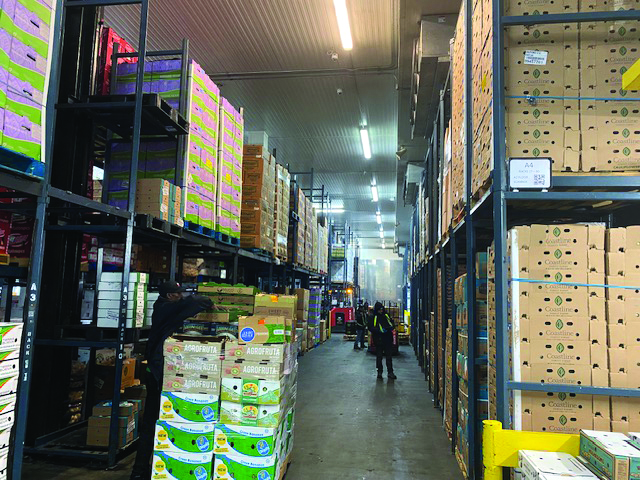
 In July 2013, Detroit filed the largest municipal bankruptcy case in U.S. history, being cited as having $18.5 billion in debt. Pictured above is the Detroit Financial District. (Photo courtesy of Wikipedia)The news wasn’t a huge surprise to produce companies who have businesses on the Detroit Produce Terminal Market. Their primary customers are, fortunately, in the suburbs surrounding the city where the economy has maintained stronger stability.
Mike Badalament, sales associate for Ram Produce Distributors LLC, located at the Detroit Terminal Market, told The Produce News that the city is at the point “where it couldn’t drop any deeper.”
“It’s had more than its share of troubled mayors, but the current mayor, Mike Duggan, and the one prior, Dave Bing, have done a good job,” he said.
Badalament added that Duggan is garnering trust from the community. He even goes out with city workers to help shovel snow off the streets. And he believes there are a lot of other great people who feel that the city will go through a gradual but strong revitalization.
Badalament is adamantly opposed to Detroit taking the drastic measure of selling the art at the city-owned Detroit Institute of Arts Museum, of which he and his wife are involved. The Institute owns one of the most extensive and precious art collections in the nation, with some pieces valued as high as $867 million. Badalament believes that the institute is among the top venues that can help bring people back to visit Detroit.
It should be noted that on Jan. 13 several major U.S. newspapers reported that a group of nine foundations pledged to pool the $330 million needed to relieve the museum of its responsibility to sell some of its collection to help Detroit pay its $18 billion in debt.
Every small step forward is an important one for Detroit, but it has some 3,500 vacated homes and is still suffering from monetary abuses caused by administrations of years past. But signs of hope are strong.
Whole Foods recently opened a store in the downtown area and reports doing much better than it anticipated, and word is spreading that they plan to expand with other stores. Meijer, which has several locations in the region, is reportedly also planning a store in the downtown area.
“The Detroit bankruptcy will have positive effect,” said Nate Stone, chief operating officer for Ben B. Schwartz, located on the Detroit Terminal Market. “The connotation of bankruptcy sounds bad, but it will provide much needed relief for the city. If you’re so far behind the eight ball in debt, why let everything continue to disintegrate and bury you more? Bankruptcy is a bad thing, but in this case, it’s going to allow the city to breathe and move ahead.”
Stone added that things like getting the trash collected, having emergency responders more able to get to where they are needed quickly and even having street lights operating sound simple.
“But when a city cannot afford them, they are monumental problems,” he said. “This bankruptcy is a fresh start for Detroit.”
Dominic Russo, buyer and sales associate for Rocky Produce Inc., also located on the Detroit Produce Terminal Market, concurs that filing for bankruptcy was the only win-win strategy left for the once bustling city that was known mostly for automobile manufacturing.
“We’re already seeing more people wanting to move downtown, and there is a lot of available space for not only homes but also commerce,” said Russo. “The police and fire departments have already had their services bumped up, and there’s a grant out for new vehicles.
“It’s going to take a few years, but every step Detroit takes now is a step in the right direction,” he continued. “Most of our produce is shipped to the suburbs, and we’re even seeing an uptick in buying confidence in these areas. People are less afraid of spending money than they were a year ago.”
Russo also fees that the auto industry will make a good comeback in Detroit, and that other major manufacturers are moving in. Michigan, as a state, had a budget surplus last year, and people are hoping that more of those funds will be filtered down to Detroit’s needs.”
“When you bottom out, the only place to go is up,” said Russo. “And up is where we finally see Detroit headed.”