Bridges close the gap between Mexican production, Texan imports, eastern U.S.
Bridges close the gap between Mexican production, Texan imports, eastern U.S.
Whether they span a border or a mountain range, bridges are increasingly important in the Texas produce industry.
The completion of the Baluarte Bicentennial Bridge, officially the Guinness Book Record holder as the tallest cable-stayed bridge in the world at 1,322 feet above the valley below and the second highest bridge of any type, open Texas for the first time to truck traffic from western Mexico.
Construction began in 2008, was completed last year, and the bridge is expected to open to traffic before the end of 2013.
Four years in the making, the bridge consists of a four-lane road 66 feet wide by 3,688 feet long, supported at a height of 1,322 feet above the Baluarte riverbed — high enough to fit the Eiffel Tower with room to spare. When the bridge opens, eastern and western Mexico will for the first time be connected by an easily traversable road.
The bridge is the final link in the reconstruction of Mexico’s Federal Highway 40, which links eastern and western Mexico via a thoroughfare that includes some 95 bridges and tunnels (11 miles of the highway are underground). The two halves of the country have forever been separated by a mountain chain — the Sierra Madre Occidentals — so torturous it has for eons been called “The Devil’s Backbone.”
It is expected that the new infrastructure will draw traffic away from Nogales, AZ, since shipping through Texas signficantly decreases freight to the U.S. East. The bigger question now is how will truck traffic from Mexico enter Texas? There are multiple options.
“It’s an engineering marvel, but what’s really awesome is not so much the engineering but actually connecting one side of the country with the other,” said Carlos Zambito of Abasto Corp., which operates the McAllen (TX) Produce Terminal Market, just across the Mexican border in the Rio Grande Valley. “In practice, Sinaloa and the West Coast have always had to [ship] to Nogales. This is going to allow people to come and use this [McAllen] border. You’re already seeing companies coming to explore this area and kind of get the feel for it — we’re closer to the East Coast, which is 80 percent of the population of the U.S., so this is a good place to be. It’s to the point where actually people from Nogales are coming to this area because of that, we’ve already got a few companies opening up shop here in the Valley, beginning to get in place for when the bridge opens. That’s already happening as we speak.”
John McClung, former president of the Texas Produce Association, agreed. “I can’t go anywhere in McAllen without tripping over a new cold storage facility,” he said.
The Texas produce season recently opened officially with a celebration at the Pharr-Reynosa International Bridge.
“The thing that’s letting us know that this area is really going to grow is the fact that the federal [Customs & Border Protection] is expecting a shift of traffic from Nogales to our area,” said Juan Guerra, chief financial officer for the city of Pharr.
Recently, the U.S. shipped a new X-ray machine — the fourth — for use at the Pharr border crossing.
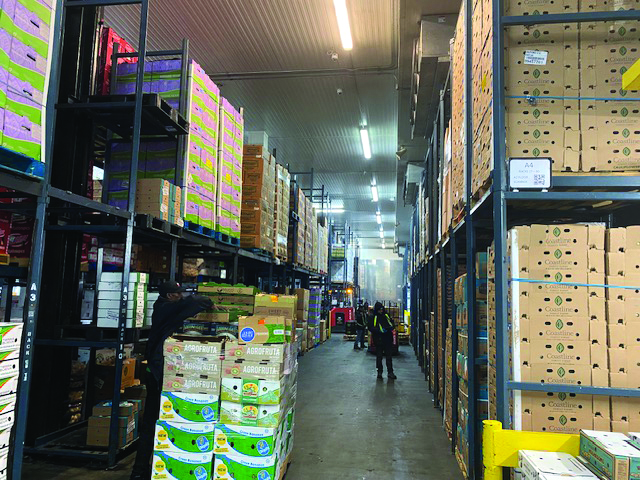
Meanwhile, Pharr has already spent $10.5 million for the first phase of its “Produce Park” project to develop 90 acres of property near the bridge into sites for produce suppliers to build cold storage and other support facilities.
The Pharr border crossing leads the nation in importing fruit like avocados, pineapples, dates, figs, melons, berries, and grapes. Pharr is the second leading portal in the U.S. for the importation of tomatoes.
But Pharr officials are looking down the road as the already completed Anzalduas International Bridge in nearby Mission, TX, will finally be staffed and ready for commercial truck traffic beginning in 2015.
Local and state officials believe both bridges will be increasingly business as the flow of product from western Mexico ramps up.
“It is possible Pharr may see a decreased rate of growth in the short term as Anzalduas opens up, but in the long run everyone will be a winner,” said Bret Erickson, president of the Texas International Produce Association.
“I think with the amount of trade that we’re seeing and the amount of redirected traffic that’s going to be coming to our international borders, we’re going to be able to continue to be competitive not only here in Pharr, but also in Mission,” added state Rep. Sergio Munoz.