Near-optimal conditions help Eastern Shore potatoes, green beans and sweet corn along
Near-optimal conditions help Eastern Shore potatoes, green beans and sweet corn along
As harvest nears for growers on the Eastern Shore of Delaware, Maryland and Virginia, they’re optimistic on yields following beneficial weather conditions as crops matured.
For many Eastern Shore growers, it was a stark change from last season.
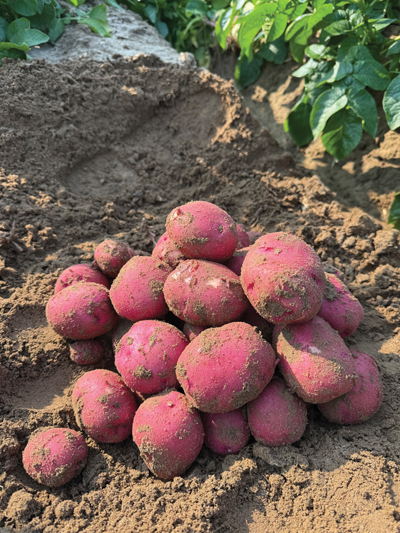 “We got no rains from Mother Nature to grow the crop last year,” said Mark Hickman, operations manager at Dublin Farms. The farm grows red, yellow and white potatoes in Accomack County, VA, one of 14 counties in the state designated a Natural Drought Disaster Area by the U.S. Department of Agriculture.
“This year the growing season has been almost the polar opposite of last year,” said Hickman.
Dublin Farms, which irrigates all of its fields, was able to produce a normal crop, and rains in July benefitted vegetables still in the ground as well.
“This year, we’ve had ideal weather. We started off a little wet and cool but once we broke out of that spell at the end of March, we’ve had ideal weather, and the potatoes are right on schedule, or a little ahead of schedule,” Hickman said.
The company planned on test digs the first week of June, with harvest likely starting by June 26, perhaps as early as June 21, five days ahead of a typical harvest kickoff.
Dublin Farms typically wraps up shipping by Aug. 10 to avoid encroaching on other production areas as they start harvests.
Hickman said the company has cut white potato production, with reds and yellows at 45 percent each.
“The white potato market for us has not been favorable,” he said. “There’s just not a lot of demand for them and we kind of get stuck with them every year. So we’ve cut that acreage back considerably over the last years.”
Ken Gad, president of South Easton, MA-based Cambridge Farms, which distributes potatoes for growers on the Eastern Shore and other regions, has seen the same drop in white potato acreage. A boost in the popularity of yellow potatoes is the primary driver of the switch from white potatoes.
Gad, who communicates often with Cambridge Farms’ suppliers, said dry regions on the Eastern Shore have benefited from perfect rains this spring. He said the Eastern Shore is typically digging potatoes after June 20, and there’s no reason to think we won’t be on time with that this year. He suspects North Carolina will be going a little bit earlier than that.
“We’ve had great temperatures without excessive heat,” he said. “We’ve had great temperatures and even relatively cool days, and it’s allowed for a really nice, even-keel growing season.”
Based on the weather conditions and early test diggings, Gad said he expects quality and sizing to be very good, with the caveat that “Mother Nature can change your quality quickly.”
“I think overall we’re going to have a good, better than average yield,” he said. “That’s not going to say we’re going to have a bumper crop.”
In Dover, DE, Tony Kaczka, president and food safety manager of Papen Farms, said the company’s green beans and sweet corn (white, yellow and bi-color) are on track for a normal harvest.
“We had a dry start to the planting season, but we have recently gotten adequate rainfall and crops are growing well,” Kaczka said.
Green bean harvest should start around June 18 for the six-week spring crop. A six-week green bean fall crop should wrap up by the end of October.
The sweet corn is also on track for a typical July 5 start, ending the first week of September.
Last season was the first year Papen Farms did not plant cabbage, due to labor availability, lower market prices and cabbage’s susceptibility to pests and disease.
“The young green beans and sweet corn plants are looking great,” Kaczka said in late May.
Last season’s heat forced irrigators like Papen Farms to heavily rely on the watering system.
While many Eastern Shore growers ship by the truckload out-of-state metropolitan terminal markets, many participate in state “locally grown” promotions, such as Virginia Grown.
“Eastern Shore fruits and vegetables are the backbone of the Virginia Grown program,” said Michael Wallace, director of communications at the Virginia Department of Agriculture and Consumer Services. “Few regions of the state of Virgina match the large acreage of vegetables grown in the Eastern Shore does. These vegetables are found in grocery stores using the Virginia Grown label on a large scale. This provides access and exposure of Virginia Grown products to all consumers, not just people attending farmers markets.”
There are 8,000-10,000 acres of vegetables grown on the Eastern Shore of Virginia, Wallace said. Leading crops are table stock and chip-stock potatoes, fresh- and process-market green beans, sweet corn for processing and fresh-market round tomatoes.