Wholesum succeeding in third year with FairTrade affiliation
Wholesum succeeding in third year with FairTrade affiliation
NOGALES, AZ — The Crisantes family, which owns Wholesum Family Farms Inc., based here, has always expressed its social conscience and cared for and invested in the well-being of its employees.
But as the FairTrade movement became more established, there were increasingly reasons for Wholesum to move toward formal FairTrade certification.
Ricardo Crisantes Sr. tells the story of his board members’ approval process prior to the FairTrade commitment three years ago.
As FairTrade ran the board’s gauntlet prior to launching at Wholesum, the concept faced the hard business and profit questions that are undoubtedly encountered by many companies as the scrutinize participation.
Immediately the Wholesum board accepted the altruistic benefits of FairTrade.
 Wholesum Family Farms workers’ children show off their FairTrade scholarship certificates. Education is an important benefit.But a lengthy conversation indicated to the board that there would be a great deal of expense involved “and they would not be guaranteed anything but reaching environmental and social objectives. They had to invest and to commit to a standard that keeps maturing and moving on.”
The board members asked about the size of retailer and consumer demand for FairTrade products. The board noted that the FairTrade move only made sense if there would be a premium paid for the products.
The board was reminded that the premium received would go to the workers, not the corporate bottom line.
“They could see the beneficial points of less employee turnover, loyalty and so forth. But if there was a premium of 65 cents a box, they would get nothing?” Not the company, Crisantes replied.
The FairTrade process involved educating the farm workers about the FairTrade program, and then organizing them to elect FairTrade committee members from their own numbers.
“That raises expectations of the employees very high,” Crisantes was reminded.
The final groundwork for Wholesum’s move ahead was laid by careful meetings with customers, who expressed enthusiasm for FairTrade. Still, Crisantes said, “in the first year there was a lot of nail biting. It raised our costs as we invested in the program. It was a leap of faith in customer interest.”
Three years down the road, the FairTrade “program as a lot of potential.” The workers committee cooperates with a couple Wholesum management representatives, consistent with the FairTrade charter. The workers’ committee always presents three options for new projects for the voting approval of all the workers.
Crisantes said that, with experience, the workers committee is becoming more sophisticated and has increasingly planning more complex projects that will be fulfilled over the next five or 10 years. Plans are percolating for the worker and FairTrade management committee to travel to see and learn from other FairTrade projects.
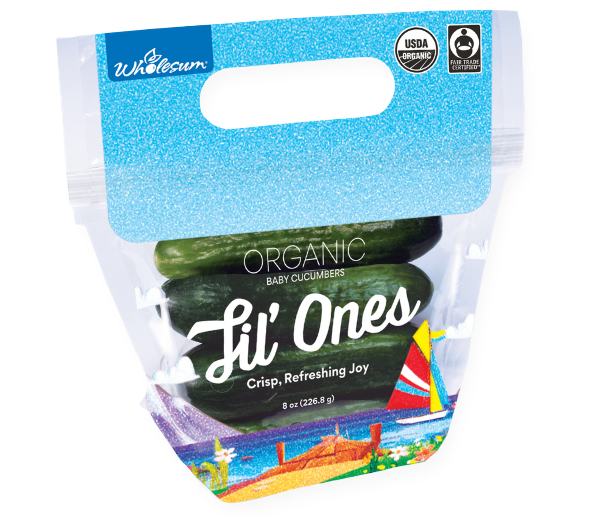
Meanwhile, Wholesum is enjoying the commercial benefit of using the FairTrade label on its qualified products. The premiums paid by consumers range between 60 and 90 cents per package, depending on the product, Crisantes said.
Many projects are now being fulfilled to benefit Wholesum workers.
There is a school bus to get workers’ children to a school that is eight miles away from a principal vineyard. The bus also is used for other activities, such as driving moms to the supermarket and driving the camp population to the cultural activities on the weekends. Plans are under way to buy a second bus to meet demand.
Wholesum provided the following description of other FairTrade programs that are already benefiting workers.
There is “a project of the laundry center aimed at working mothers so they can use their days off in another activity instead of washing.” A person can deliver up to 22 pounds of clothes to be washed, and pay less than a dollar for this service. This money is used to buy detergent, softener and some implements for laundry. The service can be accessed by 258 people. “We have an attendance of 40 people per week. We are planning to install a second washing center in another field.”
A refrigerator project in the fields started with only 12 refrigerators. “We currently have 19 coolers. In this project 155 people, of whom 75 are workers, are enjoying this benefit. Previously people had no food storage, especially migrant workers. Now they can keep fresh their food and water.” About US$12,000 have been invested in field refrigerators.
In Wholesum’s FairTrade education program, “We have a computer center where kids can go to do their jobs supported by a teacher. About 80 children attend per week. We have also conducted two computer courses for adults who want to learn basic computing.”
Furthermore, “There is a scholarship project with which 38 students are being helped, 35 students of elementary and middle school and three students of high school. Scholarships are given in the form of vouchers for US$25 and $US42 per month to each student with a minimum GPA of 80 percent.
About US$22,000 have been spent on education projects.
Up for proposed votes are a dental program and a sports program where FairTrade supports uniforms and equipment for the events of soccer, basketball and volleyball.
The firm’s Hermosillo vineyard already has a health clinic, complete with a dentist’s office.