Growers, public attend 2014 Onion Variety Field Day
Growers, public attend 2014 Onion Variety Field Day
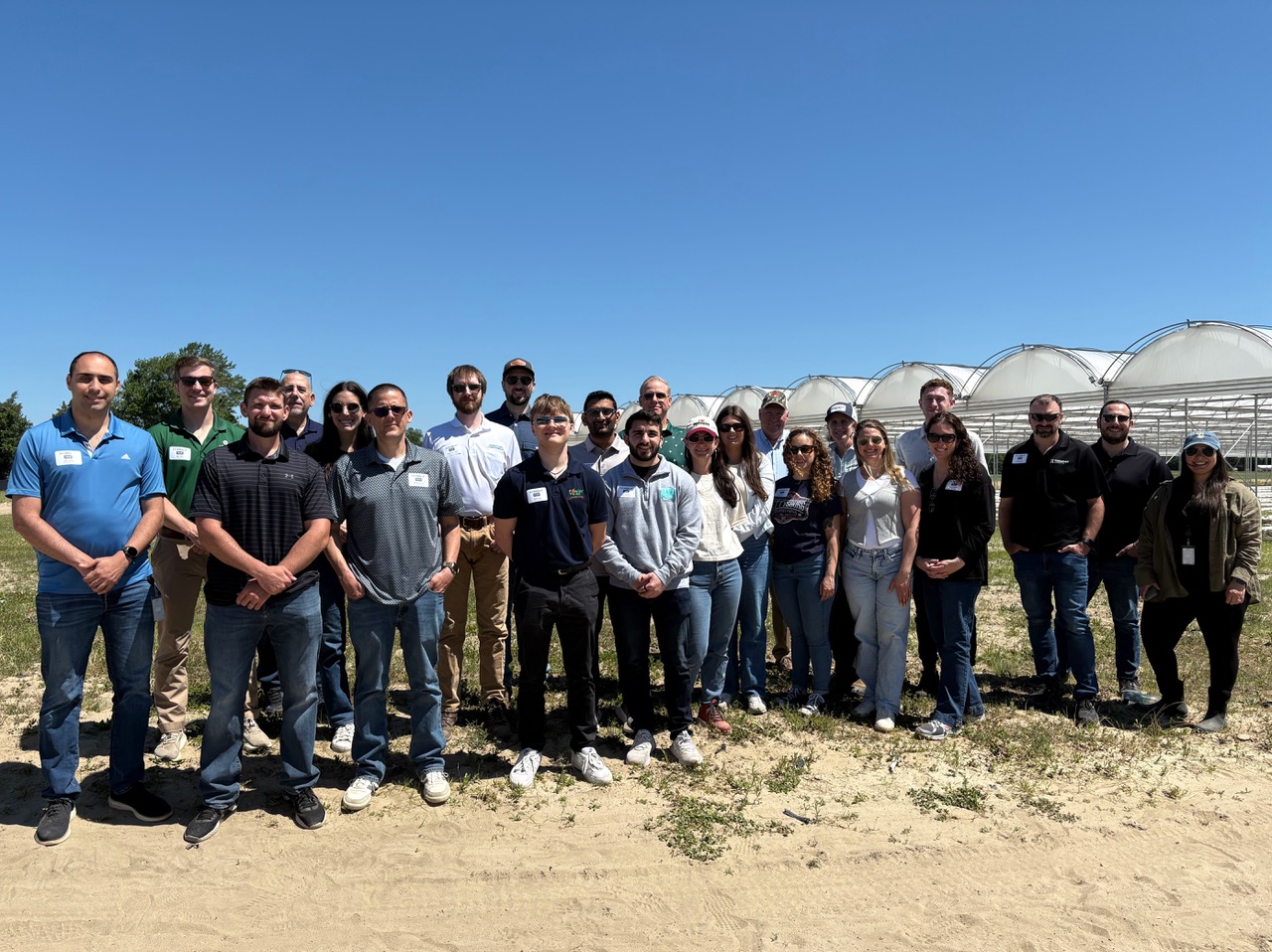
On Aug. 26, Oregon State University’s Malheur Experiment Station held its 2014 Onion Variety Field Day. Director Clinton Shock said growers and the general public were invited to find out more about the status of this year’s research and ways in which the work can have a positive impact on the region’s onion production.
“One hundred fifty people came to the Experiment Station,” said Shock.
This year, Shock said, a small trial was conducted on early harvest and transplant varieties. “A larger trial on 50 other varieties was also conducted.” All onion varieties used in trials are commercial. “Some are relatively new,” Shock went on to say. “We have some standbys and varieties that people are putting forward.”
Onion variety performance was compared under furrow and drip irrigation. “We also talked about E. coli,” Shock said.
The latest annual report, 2013 Onion Variety Trials, details status of work performed at the station. The report is authored by Shock, Erik B. G. Feibert and Lamont D. Saunders. “The objectives of the onion variety trials were to evaluate yellow, white and red onion varieties for disease, maturity, bolting, single centers, yield and grade out of storage,” the report states. “Four early-season yellow varieties were planted in March and were harvested and graded in mid-August. Forty-nine full-season varieties (39 yellow, three red and seven white) were planted in March, harvested in September 2013, and graded out of storage in January 2014. Each year, growers and seed industry representatives have the opportunity to examine the varieties at our annual Onion Variety Field Day in late August and during onion grading in early January. Varieties are evaluated objectively for maturity, bolting, onion thrips, yield, grade, single centers and storability. Varieties are evaluated subjectively for iris yellow spot virus, bulb shape, bulb shape uniformity, color and skin retention.”
The authors reported the results of their study as follows: “The rate of accumulation of growing degree-days (50-86°F) in 2013 was higher than the 23-year average; compared to 2011 and 2012, thrips pressure in 2013 was extremely high but lower than in 2012 and higher than in 2011; in 2013, the Iris Yellow Spot Virus pressure was low and did not vary by variety.”
The early-maturing trial revealed that the proportion of single-centered bulbs averaged 47.8 percent. The percentage of onions that were functionally single centered averaged 57.9 percent. Total yield averaged 835.7 hundredweight per acre.
Results for the full-season trial showed the following: bolting in furrow-irrigated onions averaged 0.7 percent; bolting for drip irrigated onions averaged 1.5 percent; the proportion of single-centered bulbs averaged 44.5 percent for furrow-irrigated onions and 57.6 percent for drip irrigated onions.
The marketable yield for furrow-irrigated onions averaged 786.2 hundredweight per acre, and the marketable yield for drip irrigated onions averaged 767.5 hundredweight per acre.
“In comparing the performance of the varieties under furrow and drip irrigation using regression analysis, the furrow-irrigated onions had slightly higher total yields than the drip-irrigated onions,” the report states. “However, the drip irrigated onions had slightly higher marketable yields and substantially higher colossal and supercolossal yields than the furrow-irrigated onions.”