Village Farms enjoying success with its new ‘Heavenly Villagio Marzano’ tomato
Village Farms enjoying success with its new ‘Heavenly Villagio Marzano’ tomato
Village Farms reach is as wide as its grasp, with greenhouses and distribution centers located throughout North America dedicated to growing a variety of product and getting it onto store shelves and into end consumers’ kitchens.
“Village Farms grows a variety of tomatoes, including our signature tomato-on-the-vine, beefsteak and Roma, as well as a number of specialty and cocktail tomatoes,” Helen L. Aquino, marketing manager for Village Farms LP, headquartered in Eatontown, NJ, said. “We also offer sweet bell peppers in red, yellow and orange. And we have long English and mini cucumbers.”
Village Farms markets all of its greenhouse produce under their trademarked names: “Delectable TOV,” “Savory Roma,” “Lip-Smackn’ Grapes,” “Juicy Beefsteak,” “Luscious Seedless Long English,” “Sweet Bells,” “Mini Sensations,” “Baby Beefs” and “Sinfully Sweet Campari.”
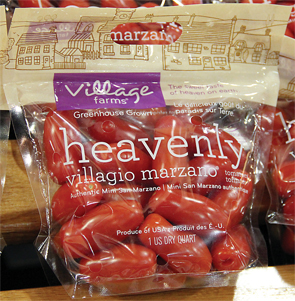
“Our newest addition is an authentic mini San Marzano plum tomato, which we have trademarked with ‘Heavenly Villagio Marzano,’ “ said Ms. Aquino. “We are the only company in North American with distribution rights to this exclusive variety.”
The company owns three greenhouse facilities totaling 110 acres in Delta, BC. Its five facilities in Marfa and Fort Davis in western Texas represent a combined 152 acres.
“Thirty acres of this is of our newest greenhouse we have just completed in Monahans, Texas,” said Ms. Aquino. “This greenhouse is like none other in the world. Modeled after our proprietary ‘GATES’ technology, it is state-of-the-art controlled environment agriculture.
“We also market 96 acres for partner growers in Mexico, 69 additional acres in Canada, and 24 acres in the U.S.,” she continued. “Today we grow, market and distribute a total for 451 acres of premium greenhouse produce.”
Village Farms has five distribution centers — in Surrey, BC, Arlington, TX, New Castle, DE, Seattle and recently opened in the Dominican Republic exclusively for bell peppers. Its full line of greenhouse produce is available year round with no supply gaps. All of its facilities are GlobalGAP-certified.
“One of the biggest advantages to hydroponic greenhouse production is consistent quality product with high food-safety standards,” said Ms. Aquino. “It is important to folks to know that in the middle of winter, or any other time of the year, they can have that ‘just picked’ flavor whenever they want it from Village Farms products.”
Village Farms’ customer profile covers the full range, but is represented mostly by club stores, major chain retailers, independent stores and some wholesale terminal markets. It also services the foodservice sector. Its products are distributed throughout the United States and Canada.
“Consumers are more into cooking now than ever, and they are preparing meals at home using quality fresh ingredients and preparing recipes with unique items that accentuate flavor profiles,” she said. “But the bottom line is that they want great taste, they want quality and they want convenience. These will be the drivers in any economy.”
Ms. Aquino said that Village Farms’ growing technique is extremely resource-efficient, making the company highly environmentally friendly. For example, growing hydroponically provides plant roots with just the water they need, and the company recycles and reuses this water up to five times.
“On a pound-for-pound basis we use 86 percent less water compared to field-grown product,” she said. “We are also able to grown more intensively, yielding three times more per acre compared to field grown. This means that a 50-acre greenhouse produces as much as a 1,500-acre farm.
“We also use very efficient boilers to heat the greenhouses, and the by-product CO2 from generating that heat is pumped into the greenhouse for the plants to grow,” Ms. Aquino continued. “This renders our growing practically carbon neutral. In addition, all of our packaging is recyclable, including our minimally dyed unwaxed cardboard boxes.”