California pomegranate industry looks for rebound crop
California pomegranate industry looks for rebound crop
For the first time in three years, the California pomegranate industry is hopeful it will have a full crop.
“We have had two poor seasons in a row," said Tom Tjerandsen, manager of the California Pomegranate Council.
In both 2016 and 2017, unseasonably early rain in October reduced each of those crops to about 4.5 million cartons. This year, he said the crop should be significantly larger. In recent history, the larger crops have approached 7 million cartons. This year, pomegranate growers have had excellent growing conditions for much of the year.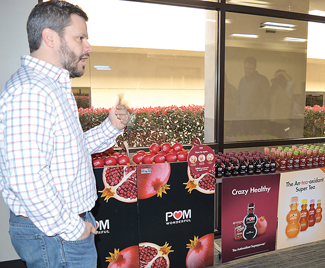 Adam Cooper, vice president of the Wonderful Company, speaks about the company’s pomegranate program during a media event this past spring.
“We’ve had no major heat spikes [during the growing season], the bloom came at the right time and we have had some coolness at night, which helps produce the bright red color [on the arils] that the consumers value,” Tjerandsen said.
On the last day of July, Tjerandsen told The Produce News that harvest of the Early Foothill variety would get under way in early August and carry the production load through September and into October, which is when the Wonderful variety will be ready for harvest. The early varieties make up about 30 percent of the crop, with the long-standing Wonderful cultivar accounting for the bulk of the production.
Tjerandsen said the early fruit typically is destined for the domestic market at the outset, with exports occurring after the domestic pipeline is filled.
“Typically, the shippers export 25-40 percent of the crop,” he said. “There are many parts of the world that prize pomegranates and especially the big, red Wonderful variety.”
Canada is the top export market for California’s crop, but Korea is also an importer as well as Japan, Taiwan, New Zealand and Australia.
“We used to ship 300,000 cartons to Russia, but that went away with the imposition of sanctions,” Tjerandsen said.
Tjerandsen listed Brazil and Central America as emerging markets for California pomegranates. He added that because of lack of production over the last couple of years, export shipments have suffered and there should be pent-up demand in many of these markets.
It is in the export markets where the council concentrates its efforts using the USDA’s Foreign Agricultural Service Market Access Program funding. It runs promotional program in several different foreign markets each year and is constantly looking for new opportunities. This year, the council has applied for funds to launch promotion programs in Costa Rica and Colombia.
Tjerandsen said domestic sales are strong and demand has been growing in response to both the proven and touted health benefits of pomegranates, as well as the year-round availability with the entry of Chile and Argentina into the U.S. marketplace in the March-to-August timeframe. The U.S. crop is typically harvested from August into February and marketed through March.
Though the popularity of the fruit is on the rise, there is still a lot of room for growth. In the United States, Tjerandsen said only about 25 percent of the population has tried a pomegranate and less than 20 percent have ever purchased a pomegranate.
Like many produce items, he said pomegranates are a high impulse item, so the key to sales is high visibility within the department. Many shippers offer standalone display bins, which give that extra merchandising lift. The Pomegranate Council executive also noted that studies have shown pomegranates to be price inelastic. For the people who buy them, price is not an overarching factor.
Tjerandsen said the California pomegranate industry is fairly stable. There are more than 200 growers in the state with an orchard of at least 10 acres. Total acreage has been estimated to be about 30,000, with The Wonderful Company being the largest producer and shipper.
Adam Cooper, vice president of marketing for The Wonderful Company and its Pom Wonderful brand, said the firm’s strategy is to capitalize on the synergies of its brand by co-marketing its Pom Wonderful juice, its fresh Pom Wonderful branded pomegranates and its fresh pomegranate arils, which are marketed under the Pom Poms banner. He said that approach has proven to create velocity of sales at the retail sector.
For its fresh whole pomegranate merchandising, it relies heavily on its bin approach, which allows retailers to display the fruit to its best favor in a prominent position in the department. Each bin features Pom Wonderful juice as well as the Pom Poms to create that connection and further motivate consumers to purchase.
The company has an array of point-of-sale materials to drive the message home for consumers. He called it a “360 campaign” that creates sales for the entire category.
Cooper reiterated that pomegranates are very much an impulse buy at retail, emphasizing that the bin and the signage and the multiple pomegranate SKUs offered by Pom Wonderful are the factors that are building demand for the category.
Pom Wonderful only markets the Wonderful variety, which, of course, is where the firm got the inspiration for its name. He noted that the company is expecting to have a good supply of whole fresh pomegranates to support their retailer program. However, he did not discuss crop size, as October rain has reduced the crop the previous two years.
Mid-October is typically when the Wonderful variety makes its entrance. It is widely accepted that the Wonderful variety offers bigger, redder and sweeter arils that consumers desire.
Cooper noted that the early varieties do offer an early opportunity for pomegranate devotees, but he believes that once the Wonderful variety is in season, retailers are well served to switch to that better-tasting product. He contends that it is the Wonderful variety that creates the velocity in the marketplace.